
Boasting excellent access to central Tokyo and a rich natural environment, Nagareyama City, Chiba Prefecture (千葉県流山市) offers the best of both worlds. The area around Nagareyama Otakanomori (流山おおたかの森) Station, in particular, has garnered immense support from child-rearing generations in recent years, firmly establishing itself as a commuter town with one of the highest population growth rates in Japan. For families considering buying a home, not only is everyday livability a priority, but maintaining and increasing future "property value" is also a major concern.
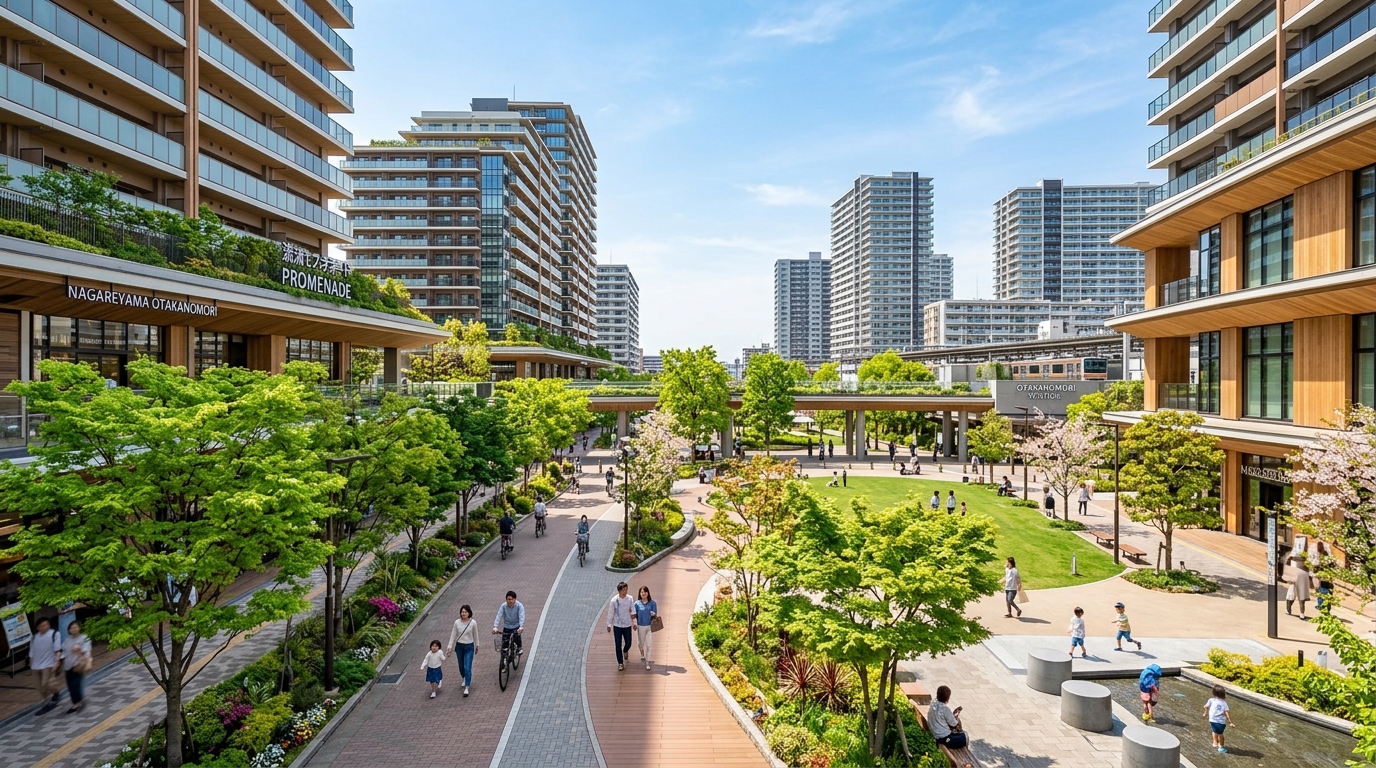
Fast forward to 2026—why is Nagareyama so highly regarded, and how does it continue to generate a virtuous cycle of visibly rising land prices? The answer lies in its child-rearing-focused urban development, highlighted by the continuous evolution of its landmark commercial facilities and powerful support systems for dual-income households, such as the Pick-up and Drop-off Nursery Station (送迎保育ステーション). In this article, we will unravel the secrets behind the livability and investment potential of the Nagareyama area from a real estate analyst's perspective, incorporating actual data from the Ministry of Land, Infrastructure, Transport and Tourism (国土交通省) and the latest redevelopment trends.
1. Why Do Families Choose Nagareyama to Buy Their Homes?
The primary reason Nagareyama is chosen as a home-buying destination is its thorough, government-led child-rearing support policies and the sustainable urban development they bring. To get straight to the point, the driving force behind Nagareyama's rising land prices is the presence of clear demand drivers—infrastructure tailored for child-rearing and steady population growth—that make people actively want to live there.
According to the latest actual data (covering the period from 2021 to 2025), the total number of real estate transactions in Nagareyama reached 3,902, forming a highly active market. The average transaction price is approximately 43.76 million yen (median: 38 million yen), with an average unit price of about 190,000 yen per square meter, maintaining high demand even among Chiba's commuter towns. Transactions range widely from a minimum of 30,000 yen to a maximum of 1.3 billion yen, demonstrating a housing supply capable of meeting diverse lifestyle needs.
Soft infrastructure and support are equally robust. As of April 1, 2026, the number of children on waiting lists for daycare centers based on national standards achieved zero, continuing the success of the previous year. Furthermore, the local government has published the new Nagareyama Child-Rearing Guidebook 2026 (ながれやま子育てガイドブック2026) and launched consultation support programs utilizing the Regional Birthrate Decline Countermeasure Key Promotion Grant (地域少子化対策重点推進交付金), showing an unwavering commitment to creating an environment where families can live with absolute peace of mind.
In this way, urban development aimed at a specific target demographic attracts an influx of people, which in turn triggers further infrastructure investment and land price appreciation. This can be considered the greatest investment potential that Nagareyama possesses.
[For Those Considering Buying Real Estate] Are you interested in detailed price trends by area or the latest off-market property information? By registering as a free member on our site, you can download exclusive market analysis reports and property documents. Please check out the latest unlisted properties today.
2. The Secret to the Livability of the City's Landmark, "Nagareyama Otakanomori"
Driving Nagareyama's development is Nagareyama Otakanomori Station, where the Tsukuba Express (つくばエクスプレス) and the Tobu Urban Park Line (東武アーバンパークライン) intersect. With a daily passenger volume of 58,200 (according to the Metropolitan Intercity Railway Company (首都圏新都市鉄道)), this vibrant area truly serves as the symbol of the city.
The secret to its livability lies in the highly designed "walkable living sphere." The station is directly connected to a large commercial facility, Nagareyama Otakanomori S.C (流山おおたかの森S・C), allowing residents to complete everything from daily grocery shopping to weekend leisure activities in one stop. Furthermore, the Nagareyama Otakanomori S.C Expansion Project began in July 2025, with commercial functions slated for further enhancement ahead of its completion in February 2027.
Additionally, the medical environment—essential for daily life—is exceptional. According to actual data, as many as 22 medical institutions are clustered around the target area. Clinics that cover everyday medical needs, such as Kokoro no Tsubasa Life Garden Chuo Clinic (心の翼ライフガーデン中央クリニック), Yonetani Clinic (よねたにクリニック), and Maruyama Dermatology Clinic (まるやま皮フ科), are widely available.
Regarding the educational environment, the area boasts highly appealing school districts that families prioritize, including the historic Yagi Kita Elementary School (八木北小学校) and the recently established, highly regarded Oguro no Mori Junior High School (おおぐろの森中学校). This high-level convergence of commerce, healthcare, and education underpins the premium real estate value of the Nagareyama Otakanomori area.
3. A Great Ally for Dual-Income Families! The Revolutionary "Pick-Up and Drop-Off Nursery Station" System
A unique system that symbolizes why Nagareyama is called a "mecca for child-rearing generations" is its Pick-up and Drop-off Nursery Station. This is a revolutionary setup where parents can drop off their children at a station located right in front of the train station, and from there, a dedicated bus shuttles the children to and from designated nursery schools across the city.
For dual-income households commuting to central Tokyo, morning and evening nursery drop-offs and pick-ups pose a significant burden in terms of both time and energy. However, by utilizing the nursery station at the train station, parents can drop off their kids directly along their daily commute route, dramatically improving time efficiency. This system has strongly encouraged power couples and families working in the city center to relocate to Nagareyama.
Moreover, Nagareyama has established a subsidy system for using the Family Support Center (ファミリー・サポート・センター), providing meticulous assistance for sick childcare or sudden overtime situations. As of 2026, these support measures are not only continuing but expanding, deeply rooting a culture that socially supports the delicate balance of child-rearing and work.
This "ease of working for dual-income couples" goes beyond mere lifestyle convenience; it acts as a powerful incentive when purchasing a home. The peace of mind that comes from knowing "we can comfortably continue working if we live here" directly translates into increased housing demand and the preservation of property values.
[Supporting Dual-Income Families in Their Home Search] Understanding region-specific systems is essential when choosing a property that balances a child-rearing environment with commuting convenience. Our site offers exclusive materials that comprehensively cover school districts and childcare facilities. Please download and utilize this detailed area information.
4. The Appeal of Child-Rearing-Focused Area Development Blending Parks and Commercial Facilities
Nagareyama's urban development has progressed under the concept of a Forest Town Center (森のタウンセンター), aiming for perfect harmony between a lush natural environment and urban functionality. Rather than rows of sterile buildings, the spatial design seamlessly connects parks and commercial facilities, offering mental breathing room for families raising children.
Looking closely at actual data, much of the target area is designated as a "Category I Exclusively Low-Rise Residential Zone" under the City Planning Act, with a building coverage ratio limit of 60% and a floor area ratio limit of 150%. This prevents the proliferation of tall buildings and preserves a spacious, green living environment with excellent sunlight and ventilation.
Let's take a look at a summary of some actual transaction data (2021–2025) in the table below.
| Property Type | District | Year Built | Area | Layout | Approx. Transaction Price |
|---|---|---|---|---|---|
| Residential (Land & Building) | Mita (美田) | 2021 | 120㎡ | 4LDK | Approx. 31 million yen |
| Residential (Land & Building) | Nonoshita (野々下) | 2000 | 165㎡ | 3LDK | Approx. 26 million yen |
| Residential (Land & Building) | Hiregasaki (鰭ケ崎) | 1983 | 100㎡ | 5LDK | Approx. 8 million yen |
| Pre-owned Condo, etc. | Oaza-Ki (大字木) | 2017 | 75㎡ | 3LDK | Approx. 34 million yen |
| Residential (Land & Building) | Oaza-Hiregasaki (大字鰭ケ崎) | 1999 | 180㎡ | 4LDK | Approx. 42 million yen |
As shown, there is a wide range of options tailored to various life stages—from newly built detached houses to older properties ripe for renovation, and pre-owned condominiums with great station access. The strict zoning regulations enhance the city's value as a "place to live," contributing to mid-to-long-term stability in real estate values.
5. The Virtuous Cycle Brought by Population Growth and Further Improvements in Daily Convenience
Nagareyama's sustained population growth has brought about a significant virtuous cycle. The influx of people attracts new investments in commercial facilities and infrastructure, which in turn further enhances the city's appeal, completing a continuous positive feedback loop.
Currently, several large-scale redevelopment projects are underway in Nagareyama:
- Scheduled for completion in November 2027: Completion of the residential tower (Sunriant Nagareyama Parknade (サンリヤン流山パークナード)) as part of the Nagareyama Station-Front Complex Development Project (流山駅前複合施設開発計画).
- Scheduled to open in March 2028: Opening of the large commercial facility under the same project.
- Scheduled to open in summer 2029: Opening of a complex facility featuring one of Japan's largest wave pools and a food court, as part of the Nagareyama IC West Project (流山IC西部プロジェクト).
In addition, around TX Nagareyama Central Park Station (TX流山セントラルパーク駅), the Integrated Specific Land Readjustment Project for the Area Surrounding the Sports Park (運動公園周辺地区一体型特定土地区画整理事業) is progressing, featuring developments like a sports park equipped with a Starbucks.
Furthermore, Nagareyama is beginning to emerge as an advanced industrial hub. While neighboring municipalities have seen a massive concentration of data centers recently—sometimes sparking anti-construction movements—Nagareyama is pioneering new initiatives leveraging the latest communication technologies. In March 2026, NTT and KCCS (Kyocera Communication Systems) completed Japan's first technical verification of "Logistics Warehouse DX." This project directly connected a logistics warehouse in Nagareyama with a 100% renewable energy data center in Hokkaido to perform AI and GPU processing remotely.
With next-generation industrial infrastructure and large-scale commercial and leisure facility developments advancing simultaneously, Nagareyama is evolving beyond the confines of a mere commuter town into a dynamic city with its own independent economic sphere.
6. Do Livable Cities Also See Land Price Increases? The Mechanics of Property Value in Commuter Towns
In the context of real estate investment and home buying, a "livable city" translates to a "city where property values rarely drop." In Nagareyama, where the population influx continues steadily, housing demand consistently outpaces supply, directly resulting in stable and rising land prices.
The graph below illustrates the trend of actual real estate transaction prices in Nagareyama City, Chiba Prefecture.
As the data reveals, while price ranges are widely distributed depending on property conditions, transactions remain exceptionally solid, centering around the median of 38 million yen. Because it satisfies the elements most valued by families—transportation convenience and an excellent child-rearing environment—at a high level, the area possesses the strength of maintaining its property prices even during broader economic downturns.
On the other hand, natural disaster risks are something you must always verify when purchasing real estate. According to hazard data from the Ministry of Land, Infrastructure, Transport and Tourism, while there is no risk of landslides (Phenomenon: None) near the target area, a flood risk of maximum inundation depth Rank 2 (0.5 to 3 meters) has been identified. With unexpected heavy rain disasters increasing nationwide in recent years, checking such hazard information beforehand and taking countermeasures, such as enhancing water damage coverage in your fire insurance, is absolutely essential when buying a home.
7. Latest for 2026! Nagareyama Area Housing Market Trends and Future Outlook
Looking at the housing market trends in the Nagareyama area as of 2026, against the backdrop of soaring prices for newly built condominiums, high-quality pre-owned condos and pre-owned detached houses with large land areas are garnering even more attention.
Even in the actual data introduced earlier, a "Pre-owned Condo, etc." (built in 2017, 75㎡) in the Oaza-Ki district traded for about 34 million yen, indicating that relatively new, well-managed properties find buyers almost instantly. Furthermore, as seen with the "Residential" property (built in 1999, 180㎡) in the Oaza-Hiregasaki district trading for roughly 42 million yen, detached houses with spacious lots are receiving strong support from end-users desiring a "study room or garden" following the widespread adoption of remote work.
As for the future outlook, with the completion of the Nagareyama Otakanomori S.C Expansion Project and upcoming milestones for major projects like the Nagareyama Station-Front Complex Development Project, overall convenience in the area will further improve. Consequently, analysts predict that real estate prices will remain firm. At a time when condo prices in central Tokyo have soared out of reach for the average family, the relative value of Nagareyama—maintaining direct access to the city center while offering abundant greenery and robust child-rearing support—is poised to rise significantly in the future.
[Grasp the Latest Market Trends in Real Time] To succeed in buying a property in the Nagareyama area, it is crucial to have an accurate sense of market prices. Our site offers free access to area-specific price forecast reports based on the latest transaction cases. Please leverage these to inform your investment decisions.
8. Conclusion: Key Points for Choosing a City That Balances a Child-Rearing Environment with Future Property Value
In this article, we have explained the secrets behind the livability and property value of Nagareyama City, Chiba Prefecture, with a special focus on the area around Nagareyama Otakanomori.
Leading child-rearing support policies that outpace other municipalities, such as achieving zero daycare waiting lists and the Pick-up and Drop-off Nursery Station system, along with spacious urban development based on the Forest Town Center concept, continue to attract young families and generate sustainable municipal growth. Furthermore, the city's evolution will not stop beyond 2026, driven by commercial facility expansions, the Nagareyama IC West Project featuring a massive wave pool, and its development as a hub for cutting-edge "Logistics Warehouse DX."
A home is the largest purchase—and investment—of your life. Balancing the practical perspective of "Is this a comfortable place for us to live?" with the asset-value perspective of "Can we rent or sell it to someone in the future?" is the secret to flawlessly choosing the right city. Assuming you fully grasp caveats like hazard risks, Nagareyama, with its proven mid-to-long-term potential, is an area we can confidently recommend.
Good news for those who want to dive deeper into property hunting and area research! By registering as a free member on our site, you will be able to directly pull the Ministry of Land, Infrastructure, Transport and Tourism data used in this blog into your Claude or ChatGPT (via MCP integration). Rather than just a promotional gimmick, this offers the highly practical benefit of allowing you to continue researching until you are fully satisfied using your own AI assistant, so please take full advantage of it.