
1. Introduction: Hakone's Real Estate Market Draws Attention in 2026 Amid an Influx of Wealthy Residents
As of 2026, Hakone-machi, Ashigarashimo-gun, Kanagawa Prefecture (神奈川県足柄下郡箱根町) is experiencing unprecedented attention within Japan's resort real estate market. While Hakone has long held a solid reputation as one of Japan's premier hot spring (onsen) destinations, recent years have seen a resurgence in demand for luxury villas among both domestic and international high-net-worth individuals. Coupled with a series of concrete development plans by foreign luxury hotel brands, property values—particularly in premium areas—are being significantly driven up. With inbound tourism demand fully recovered, the brand power of the entire area has entered a new phase.
In this article, we will objectively analyze the latest transaction data from the Ministry of Land, Infrastructure, Transport and Tourism (国土交通省) as well as municipal support programs. We will thoroughly examine Hakone's potential not only from an investment perspective but also its appeal and true livability for end-users (families and singles) considering remote work or a dual-life lifestyle.
To get straight to the point, the current rise in land prices in the Hakone area is not a passing fad. It is a structural shift backed by a clear demand driver: the transformation into a "global-standard luxury resort." At the same time, generous childcare support and housing subsidy programs implemented by the local government have evolved the area into an incredibly attractive option for prospective homebuyers.
2. The Impact of Successive Foreign Luxury Hotel Openings on Land Prices
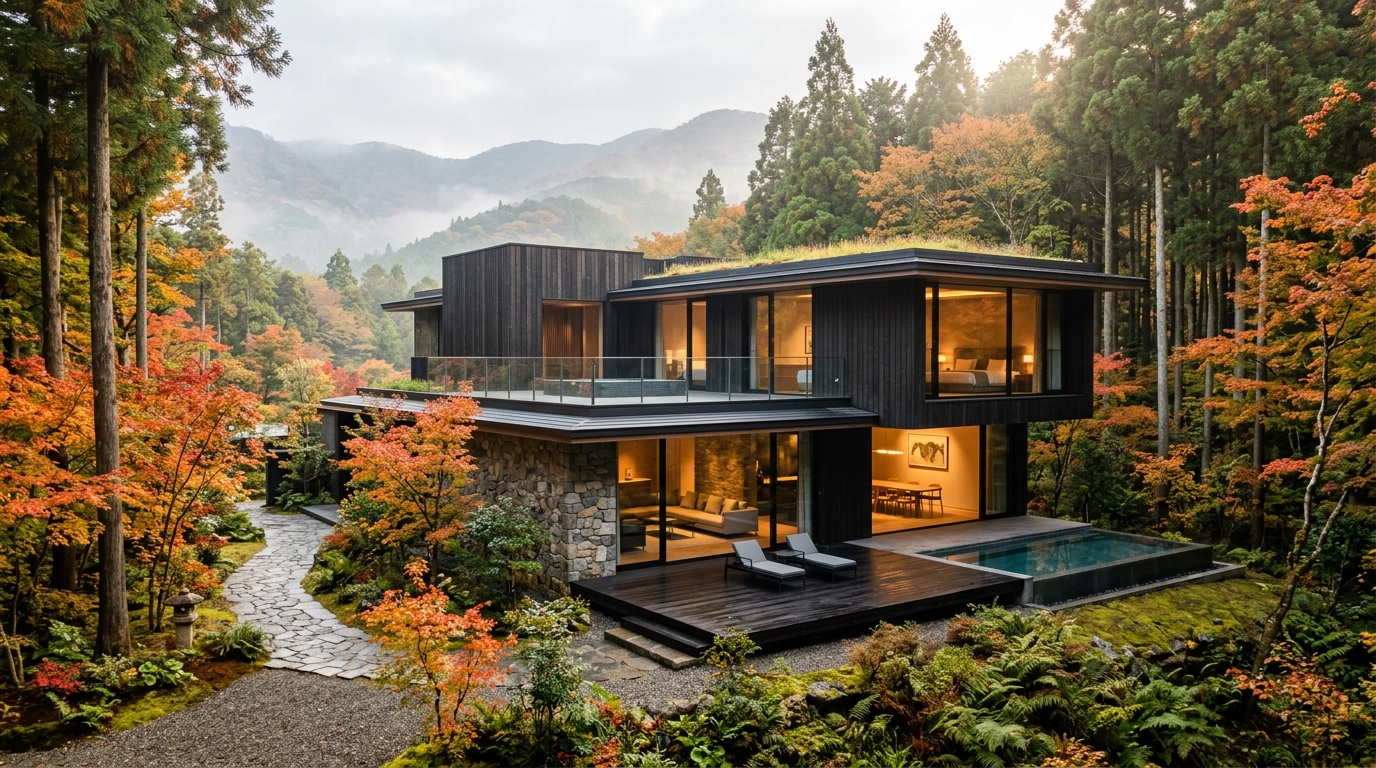
The biggest factor driving the real estate market in the Hakone area is the successive entry of global luxury hotel brands and the large-scale redevelopment projects that accompany them. Following the trends from 2026 to 2028 makes it clear that Hakone is transforming from a mere "domestic tourist destination" into an "international luxury resort."
The latest major entry and development schedules are as follows:
- Scheduled to open in 2026: "HOTEL THE MITSUI HAKONE"
- Scale: A sprawling 135,000 square meter site featuring 126 guest rooms, all equipped with natural hot spring baths.
- Features: The pinnacle brand of the Mitsui Fudosan Group. Partnering with Marriott International's "The Luxury Collection," it serves as a core for inbound tourism, attracting wealthy travelers from around the globe.
- Scheduled to open in 2028: "Alila Sengokuhara Hakone" (アリラ 仙石原 箱根)
- Scale: 60 rooms (planned).
- Features: The first landing in Japan for Hyatt's luxury brand "Alila." Redefining the value of Sengokuhara (仙石原) as an eco-luxury resort that emphasizes harmony with the natural environment.
- Scheduled to open in Summer 2028: "LXR Hotels & Resorts (Gora)"
- Features: Hilton's luxury collection brand makes its first foray into Hakone, offering high-end stays that allow guests to enjoy the nature and art of Gora (強羅).
- Scheduled to open in late 2028: "NOI by RIHGA Hakone Gora" (ノワ・バイ・リーガ 箱根強羅)
- Scale: 90 rooms (all rooms over 53 square meters, complete with open-air hot spring baths).
- Features: A new brand by Royal Hotel. Positioned as a major hub in the eastern market, rivaling Arima Onsen (有馬温泉) in the Kansai (関西) region to the west.
The concentration of such global-standard accommodations is accelerating infrastructure improvements around the area and creating new jobs, which directly leads to an overall increase in surrounding land prices. For investors, these clear redevelopment schedules and the influx of massive capital serve as crucial evidence for anticipating future capital gains.
👉 Check out the latest off-market properties and exclusive materials in the Hakone area
3. The Resurgence of Luxury Villa Demand: Asset Values in Premium Areas like Gora and Sengokuhara
Thriving alongside hotel developments is the demand for luxury villas among the wealthy. In premium areas like Gora and Sengokuhara, which boast a history of being beloved by business magnates and literary figures since ancient times, high-value real estate transactions are frequently taking place due to the scarcity of these locations.
Let's look at actual transaction data (a sample from Q1 2021). In the Gora area, a sprawling 9,999 square meter residential plot with a reinforced concrete (RC) structure built in 1989 (Category I Residential Zone, 60% building coverage ratio, 200% floor area ratio) was traded for a staggering approximately 420 million yen. Furthermore, a 1,000 square meter plot located in the Category I Exclusively Low-Story Residential Zone (30% building coverage ratio, 50% floor area ratio) in the Sengokuhara area was sold for 29 million yen (roughly 29,000 yen/sqm). This clearly illustrates the strong demand for villas among those seeking lush natural environments and spacious plots.
On the other hand, there are also cases in the Gora area where a pre-owned RC condominium built in 1990 (2LDK, 85 sqm) was sold for just 3 million yen. As this shows, a defining characteristic of Hakone's real estate market is the coexistence of an extremely wide range of price points, from multi-hundred-million-yen luxury properties to affordable resort condos ripe for renovation.
The reasons the wealthy choose Hakone as a base for second homes or "workations" lie in its excellent access from central Tokyo, high-quality hot springs, and natural environments that change beautifully with the seasons. Sengokuhara and Gora, in particular, are well-equipped with high-end leisure facilities such as art museums and prestigious golf courses, cementing their status as "premium areas" where asset values are resilient against depreciation.
4. A Must-Read for Investors! The Latest Land Price Uptrend in the Resort Town of Hakone
Let's analyze the land price trends and the current state of the real estate market using objective figures derived from actual transaction data for the entirety of Hakone-machi. Below is statistical information based on 667 actual transactions collected between 2021 and 2025.
| Item | Data Details |
|---|---|
| Target Period | 2021–2025 |
| Transaction Sample Size | 667 cases |
| Average Transaction Price | Approx. 22.86 million yen |
| Median Transaction Price | 9 million yen |
| Price Range | Min 10,000 yen – Max 1.5 billion yen (1,500 million yen) |
| Average Unit Price | Approx. 30,000 yen/sqm |
What can be gleaned from this data is the significant disparity between the average transaction price (approx. 22.86 million yen) and the median price (9 million yen). This indicates that while a handful of ultra-expensive hotel plots and luxury mansions (up to 1.5 billion yen) are heavily skewing the average upward, end-user properties such as typical detached houses, villa plots, and condominiums are actively trading around the 10-million-yen mark.
When viewed as an investment environment, certain commercial zones in Hakone-machi permit high-density land use with an 80% building coverage ratio and 400% floor area ratio, offering ample potential for the development of income-generating properties.
However, one must also be mindful of challenges unique to resort areas. In some transaction data, fields such as unit price, layout, and building age are left null, undeniably reflecting the thinness of publicly available transaction data. Because individual properties vary so greatly, it is imperative not to make judgments based solely on superficial numbers or yields, but rather to conduct meticulous comparative analyses against neighborhood market rates.
👉 For Investors: Download materials on high-yield, off-market resort properties in the Hakone area
5. Appealing to End-Users Too? Hakone as a Base for Remote Work and Dual-Life Living
Hakone is not a market exclusively for the wealthy and investors. It has also become a highly attractive relocation destination for typical families and singles. In particular, the normalization of remote work has established a new lifestyle of "commuting to Tokyo a few times a week and working from a nature-rich home the rest of the time," leading to a surge in real estate demand for end-use.
Serving as a vital transportation hub, Hakone-Yumoto Station (箱根湯本駅) on the Odakyu Hakone (小田急箱根) line sees 10,157 passengers daily. Utilizing the Limited Express Romancecar allows for direct access to Shinjuku (新宿) in about 75 minutes. This exquisite sense of distance greatly contributes to improved physical and mental well-being in a dual-life arrangement.
Looking at transaction examples for end-users, a wooden detached house built in 1968 in the Ninotaira (二ノ平) area (residential plot of 430 sqm, Category II Exclusively Low-Story Residential Zone, 40% building coverage ratio, 80% floor area ratio) was sold for 24 million yen. Additionally, a 480 sqm plot located in a Neighborhood Commercial Zone (80% building coverage ratio, 200% floor area ratio) within the same area was traded for 23 million yen (approx. 48,000 yen/sqm). Meanwhile, a wooden detached house built in 1983 in the Yumotochaya (湯本茶屋) area (residential plot of 660 sqm, Category I Residential Zone, 60% building coverage ratio, 200% floor area ratio) was sold for 10 million yen.
As condominium prices in central Tokyo continue to soar, the ability to acquire a home with a spacious garden and a private hot spring for somewhere in the 10 to 20 million yen range is an immeasurable advantage for end-users.
6. The Reality of Livability: Natural Environments, Hot Springs, Childcare, and Everyday Shopping
Many might wonder, "Isn't living in a resort town inconvenient?" However, Hakone-machi is putting immense effort into promoting permanent residency, resulting in well-developed living infrastructure and administrative services.
First, regarding the educational environment, public schools such as Yumoto Elementary School (湯本小学校) and Hakone Junior High School (箱根中学校) offer dedicated, small-class education deeply rooted in the community. On the medical front, institutions covering everyday healthcare needs—such as Tsuchiya Clinic (土屋医院), Lion Dental Clinic Hakone-Yumoto (らいおん歯科クリニック箱根湯本), and Hakone Dental Clinic (箱根歯科医院) (a sample of three in the area)—are well-distributed, providing peace of mind.
As for everyday shopping, while there are no large shopping malls within the town, a 20-to-30-minute drive grants access to the extensive commercial facilities in neighboring Odawara City (小田原市). Furthermore, online supermarkets and cooperative delivery services have become widely popular in recent years, meaning residents rarely feel inconvenienced when procuring daily necessities.
What deserves special mention are the generous childcare support and housing subsidy programs rolled out by Hakone-machi. As of 2026, the town offers the following attractive initiatives:
- Free Childcare and School Lunches: Childcare fees for children aged 0 to 5, as well as school lunch fees at municipal elementary and junior high schools, are entirely free.
- Pediatric Medical Expense Subsidies: Out-of-pocket medical expenses for children from birth to age 18 are subsidized.
- Hakone-machi Young Household Home Acquisition Subsidy Program: If a married couple under 40 or a household with pre-elementary-school children acquires a home in the town and settles permanently, a portion of the acquisition cost (up to 1 million yen) is subsidized.
- Private Rental Housing Rent Subsidy Program: A rent subsidy of up to 20,000 yen per month is provided for newlyweds and young households moving into the area.
It is rare nationwide to find a municipality that offers such robust support for "everyday life" right in the middle of an "extraordinary" resort environment filled with lush nature and hot springs. For families raising children, Hakone is not merely a vacation retreat; it holds the potential to become an "ideal hometown" where they can settle down and build a life.
7. Precautions and Tips for Choosing an Area When Buying a Home or Villa in Hakone
While the Hakone area is brimming with charm, one absolute necessity when purchasing real estate is checking hazard risks. Because Hakone features a topography surrounded by steep mountains, preparedness for natural disasters is essential.
According to the latest data from the Ministry of Land, Infrastructure, Transport and Tourism and the Geospatial Information Authority of Japan (国土地理院), clear risks exist in certain areas of Hakone-machi.
- Flood Risks: Some areas are designated with a maximum depth rank of "4," meaning inundation of 5 to 10 meters is anticipated in the event of an emergency.
- Landslide Risks: The danger of severe phenomena occurring, particularly "debris flows" and "steep slope failures," has been pointed out. Scenic villa communities developed by carving into mountain slopes often carry these risks in exchange for their beautiful views.
When buying real estate, it is imperative to cross-reference not only positive conditions like views, the presence of hot springs, and distance from the station, but also the exact location of the property against the latest hazard maps issued by the local government. Especially when considering villas built on slopes or properties along rivers, thoroughly verifying the durability of retaining walls and the results of ground surveys alongside an expert is an ironclad rule for protecting both your assets and your life.
8. Conclusion: Future Prospects for the Hakone Area, Where Investment and a Rich Lifestyle Go Hand in Hand
In 2026, Hakone-machi is buzzing with a rush of foreign luxury hotel openings and villa demand from the wealthy. The upward trend in land prices is based on clear evidence, making it undeniably an attractive market for investors looking to secure capital gains.
At the same time, thanks to excellent transit access and generous childcare support programs, cases of remote workers and families considering relocation for an "end-use primary home" are surging. High asset value as an investment and the livability that enriches one's life—the true strength of the current Hakone area lies in its ability to balance these two elements at an incredibly high level.
The most crucial aspect of real estate purchasing and investment decisions is accessing objective, accurate primary data. Why not see for yourself the transaction prices and hazard information introduced in this article?
By registering for a free membership, you will be able to pull the Ministry of Land, Infrastructure, Transport and Tourism data used in this blog directly from your Claude or ChatGPT (via MCP integration). There is a massive advantage in being able to seamlessly continue your research with your own AI before even contacting a real estate agency. We invite you to take advantage of this next-generation real estate research experience.