
When considering buying a home or investing in real estate in a regional hub city, the phrase "station-front redevelopment" often generates high expectations. However, misjudging the scale or timeline of such plans can lead to unexpected disappointments. In Yamagata City (山形市), the prefectural capital of Yamagata Prefecture (山形県), multiple urban development projects are advancing simultaneously as of 2026—ranging from improvement plans on both the east and west exits of JR Yamagata Station (JR山形駅) to revitalization in the central Nanokamachi (七日町) district, suburban industrial parks, and even the basic design of a new southern railway station.
This article examines the real estate value and everyday living conditions from the area around JR Yamagata Station to suburban residential neighborhoods, drawing on transaction data from the Ministry of Land, Infrastructure, Transport and Tourism (MLIT, 国土交通省) "Real Estate Information Library" (2,778 transactions from 2021 to 2026), hazard information from the Geospatial Information Authority of Japan (国土地理院), and the latest urban planning documents released by Yamagata City and JR East (JR東日本).
Beyond the post-2030 expectations driven by redevelopment, we objectively organize the realities of basin-specific snow countermeasures, the maintenance costs of a car-dependent society, and the factors behind price differences between the city center and the suburbs. Use this as a reliable benchmark when considering purchasing a detached house, land, or condominium in Yamagata City.
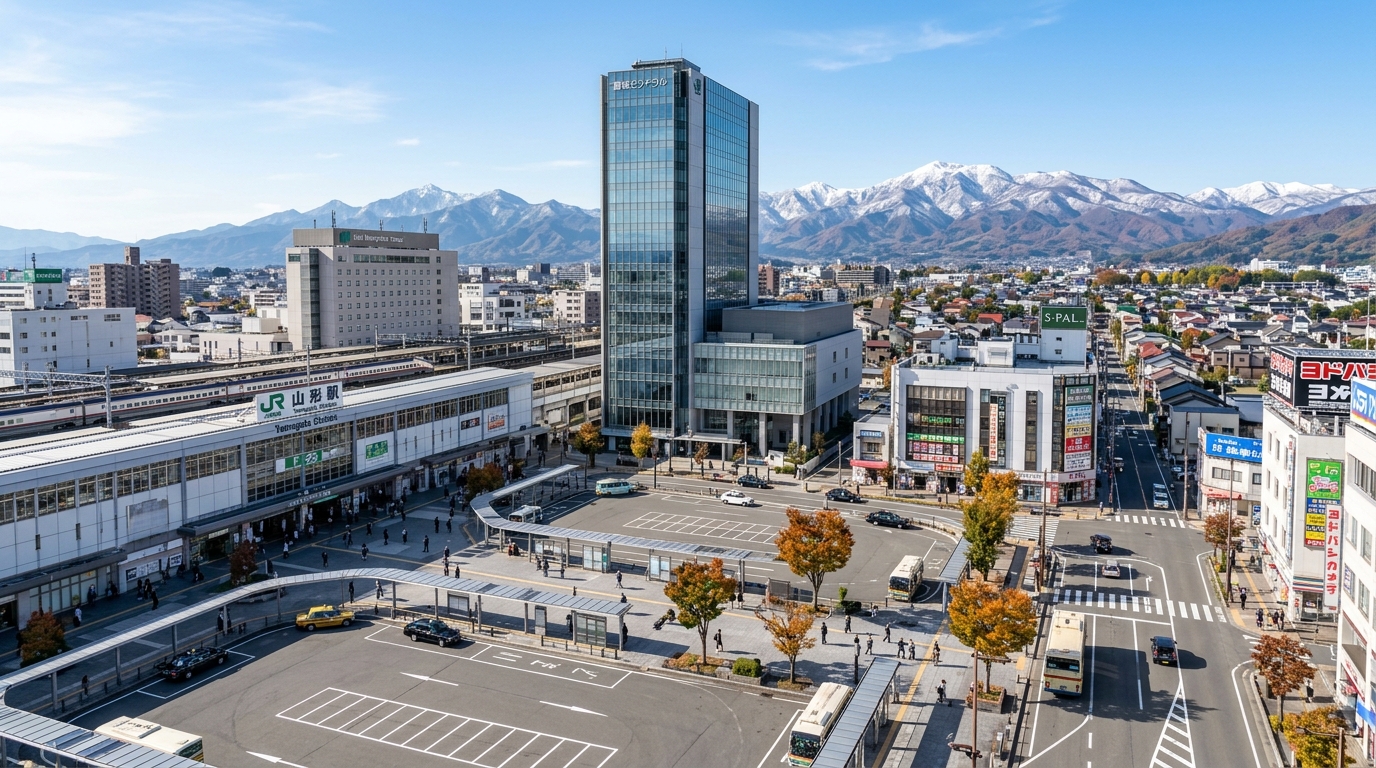
1. Redevelopment Schedule Around JR Yamagata Station and Outlook for 2030
To summarize the conclusion upfront, Yamagata City's real estate value heading toward 2030 is not moving toward "over-concentration around the station." Instead, it is heading toward a structure where enhanced tourism and exchange functions on the east and west sides of the station, long-term revitalization of the central urban area, and the development of suburban industrial and transportation hubs gently share roles.
Unlike metropolitan redevelopments where massive office buildings and commercial complexes spring up in a short period, some large-scale projects in Yamagata City have seen construction extensions or phased development looking ahead to 2040. Rather than assuming short-term price spikes, it is crucial to identify where living convenience and employment bases will take root. Let's first review the schedules of the major ongoing projects.
| Target Area / Project Name | Main Plan Details & Scale | Progress / Target Timeline (as of Nov 2026) | Source |
|---|---|---|---|
| Yamagata-Kita Interchange Industrial Park (山形北インター産業団地) | Industrial park northeast of Yamagata-Kita IC (23 plots) | Land development completed Feb 2026; on sale (over 80% sold) | Yamagata City / Prefecture materials |
| City Tower Yamagata Honcho (シティタワー山形本町) | 20-story, 149-unit, 3-retail-unit base-isolated condo | Completed Sep 2026; some units on sale (move-in scheduled 2027) | Sumitomo Realty & Development overview |
| Yamagata Station East Exit "Japan's Best Tourist Information Center" | Integrated development of ticket gate front, free passage, and former Yamagata Vivre site | Basic concept formulated Nov 2024; service expected FY2027 or later | Yamagata City published materials |
| Yamagata Station West Exit Bustling Hub Development | Utilization of JR-owned land in Futabacho 1-chome (approx. 1,830㎡), etc. | Sounding survey results published Aug 2026 (many mixed-use proposals) | Yamagata City / JR East |
| Ou Main Line (奥羽本線) New Station (between Zao and Yamagata) | Southern city transport hub with 2 side platforms, 2 tracks, and free passage | JR East solicited outline/basic design in Sep 2026 (design scheduled through Dec 2027) | JR East published materials |
| New Yamagata Civic Hall Project (新・山形市民会館) | 1,200-seat main hall, etc. on former Prefectural Hall site in Nanokamachi | Construction extended due to material delays; completion Dec 2030, opening expected FY2031 | Yamagata City / Press releases |
| Nanokamachi 1st Block East District Redevelopment | Integrated redevelopment around former Onuma Yamagata Main Store to City Hospital Saiseikan | Redevelopment preparatory association established Apr 2026; targeting FY2040 completion | Yamagata City official website |
Looking around JR Yamagata Station, on the east exit side, development of "Japan's Best Tourist Information Center" (including the former Yamagata Vivre site) is progressing toward opening in FY2027 or later, strengthening its function as a gateway to encourage stays and circulation by out-of-prefecture and inbound visitors. On the west exit side, the results of a market sounding survey conducted jointly by Yamagata City and JR East were released at the end of August 2026, with four operators submitting proposals for a mixed-use complex combining retail, accommodation, health promotion, and residential functions on the roughly 1,830㎡ JR-owned site. Alongside the existing Kajo Central (霞城セントラル) and Yamagin Kenmin Hall (やまぎん県民ホール), increased east-west pedestrian flow will boost convenience within walking distance of the station.
However, in the central Honcho (本町) and Nanokamachi areas, while private investment is advancing—such as the new Yamagata Bank head office completed in autumn 2025 and "City Tower Yamagata Honcho" completed in autumn 2026—the opening of the New Civic Hall was pushed back by 1 year and 9 months from FY2029 to FY2031 due to material procurement and changing labor conditions in the construction industry. Statutory redevelopment around the former Onuma site is also a long-term project targeting FY2040. Therefore, it is realistic to view the 2030 cityscape as one where convenience improvements immediately around the station and wide-area networks like suburban industrial parks and the new southern station take the lead, while full-scale area redevelopment toward Nanokamachi bears fruit sequentially in the 2030s and beyond.
2. Land Price Trends and Transaction Volume in Yamagata City: Decoding the Price Gap Between Station-Front and Suburbs
To objectively grasp the real estate market in Yamagata City, we analyze actual transaction data including the surrounding area of JR Yamagata Station (survey point: Yamagata City, Yamagata Prefecture, around lat=38.2487, lng=140.3274).
[Yamagata City Transaction Statistics Summary (2021–2026, 2,778 transactions)]
- Average Transaction Price: Approx. ¥22.86 million (Min ¥5,000 – Max ¥910 million)
- Median Transaction Price: ¥15.00 million
- Average Unit Price: Approx. ¥58,000/㎡
- Source: Compiled by our company from MLIT Real Estate Information Library transaction data (minimum value includes special transactions such as fractional shares or farmland).
The fact that the median price remains at ¥15.00 million against an average of approx. ¥22.86 million indicates that while large commercial land transactions push up the average, general end-user transactions take place across a wide range centered around ¥10 million to ¥20 million. Next, to check more recent market shifts by property type, we compiled quarterly trends from Q2 2024 to Q1 2026.
| Quarter | Pre-owned Condos (Count / Median Unit Price / Median Total) | Residential Land Only (Count / Median Unit Price / Median Total) | Residential Land & Building (Count / Median Unit Price / Median Total) |
|---|---|---|---|
| 2025Q1 | 11 / Approx. ¥243,000/㎡ / ¥17.00M | 35 / Approx. ¥66,000/㎡ / ¥14.00M | 53 / Approx. ¥93,000/㎡ / ¥26.00M |
| 2025Q2 | 22 / Approx. ¥262,000/㎡ / ¥19.00M | 53 / Approx. ¥58,000/㎡ / ¥13.00M | 53 / Approx. ¥94,000/㎡ / ¥22.00M |
| 2025Q3 | 16 / Approx. ¥160,000/㎡ / ¥8.00M | 45 / Approx. ¥66,000/㎡ / ¥15.00M | 58 / Approx. ¥110,000/㎡ / ¥24.00M |
| 2025Q4 | 14 / Approx. ¥173,000/㎡ / ¥11.00M | 48 / Approx. ¥64,000/㎡ / ¥14.00M | 65 / Approx. ¥73,000/㎡ / ¥25.00M |
| 2026Q1 | 20 / Approx. ¥227,000/㎡ / ¥17.00M | 19 / Approx. ¥58,000/㎡ / ¥14.00M | 48 / Approx. ¥118,000/㎡ / ¥24.00M |
| YoY Change | -6.7% (Median Unit Price) | -12.1% (Median Unit Price) | +26.8% (Median Unit Price) |
Source: Quarterly aggregation by our company of MLIT Real Estate Information Library transaction data
Three key characteristics emerge from the data. First, the main drivers of transactions are "detached houses (land and building)" and "land." While condo transactions remain at 11 to 22 per quarter, land and detached houses combined hover around 90 to 110 transactions, meaning the detached-house market sustains the city's liquidity.
Second, in Q1 2026, the median unit price for "residential land (land and building)" rose +26.8% YoY (approx. ¥118,000/㎡), yet the median total transaction price remained stable at ¥24.00 million, within the recent two-year range (¥22.00M–¥26.00M). This reflects a market structure where persistently high construction costs and increased circulation of newer or newly built spec homes on compact lots push up unit prices, while buyers' budget ceilings cluster around ¥25 million. Similarly, the median total price for "land" has held firm at ¥13.00M–¥15.00M; the -12.1% YoY dip in Q1 2026 (approx. ¥58,000/㎡) is likely influenced by the location mix during a quarter with only 19 transactions.
Third, looking at individual transaction samples from Q1 2026, price levels vary significantly even within Yamagata City depending on area, zoning, and building age:
- Central Urban Area (Aioicho / Pre-owned Condo): ¥11.00M (3LDK, 65㎡, built 1989, SRC structure, Commercial Zone, BCR 80% / FAR 400%)
- West of Station Residential Area (Akanegaoka / Detached House): ¥11.00M (185㎡, built 1976, wooden, Category 1 Low-Rise Exclusive Residential Zone, 50% / 100%)
- East of City Center (Akoyacho / Detached House): ¥13.00M (270㎡, built 1965, wooden, Category 2 Mid/High-Rise Exclusive Residential Zone, 60% / 200%)
- East of City Center (Asahimachi / Detached House): ¥26.00M (195㎡, built 1999, light-gauge steel, Category 2 Mid/High-Rise Exclusive Residential Zone, 60% / 200%)
- Southern Area (Iida / Detached House & Land): Detached house ¥7.80M (3LDK, 185㎡, built 1975, wooden, Quasi-Industrial Zone); Land ¥67.00M (760㎡, approx. ¥88,000/㎡, Quasi-Industrial Zone)
Looking at the top districts by recent transaction volume, "Tokamachi" (十日町, 19 transactions, median ¥200,000/㎡) leads for pre-owned condos, "Ochiaimachi" (落合町, 12 transactions, median ¥68,000/㎡) for land, and "Koshirakawamachi" (小白川町, 10 transactions, median ¥118,000/㎡), "Kitamachi" (北町, 9 transactions, median ¥45,000/㎡), and "Ochiaimachi" (8 transactions, median ¥180,000/㎡) for detached houses (land and building). Furthermore, comparing prefectural benchmark land prices (as of July 2026) with neighboring municipalities, Yamagata City averages approx. ¥78,000/㎡ (+0.26% YoY), compared to approx. ¥35,000/㎡ (+1.06% YoY) in Tendo City (天童市) to the north and approx. ¥29,000/㎡ in Higashine City (東根市). Yamagata City maintains land prices more than double those of surrounding cities while exhibiting gentle stability rather than rapid appreciation.
3. Strengths of the Yamagata Station Area & City Center: Alluvial Fan Ground and Castle-Town Infrastructure
Why do Yamagata City's center and station area maintain resilient transactions and land price levels even among regional cities facing population decline? There are geographical and historical reasons beyond mere shopping convenience.
Solid Ground and Disaster Resilience from the Mamigasaki River Alluvial Fan
Yamagata City's central urban area spreads across a vast "alluvial fan" formed by the Mamigasaki River (馬見ヶ崎川) flowing down from the Zao mountain range to the east. Alluvial fans consist of well-drained strata primarily made of sand and gravel, offering a topographical advantage of more stable ground compared to coastal reclaimed land or soft alluvial lowlands.
Checking official hazard data for the survey point near the east side of JR Yamagata Station and the city center (lat=38.2487, lng=140.3274, Category 2 Residential Zone, BCR 60% / FAR 200%) shows no flood inundation risk and no landslide risk. Securing an area in the city center that is less susceptible to direct river flooding or steep-slope collapse provides significant peace of mind for long-term residence and asset preservation.
Concentration of Medical, Educational, and Living Infrastructure from Castle-Town Roots
Having developed as a castle town and merchant town since Shiba Kaneyori (斯波兼頼) entered the region in 1356, central Yamagata City concentrates administrative, medical, and educational facilities within a compact radius. Around the survey point alone, 14 medical institutions—including the Yamagata City Health Center, Tanaka Dermatology Clinic, and Nakajima Eye Clinic—are confirmed, and the school district falls within the historic Daiichi Elementary School and Daisan Junior High School zones. In recent years, Yamagata City has championed a top-level vision of becoming an "Advanced Health & Medical City and Creative Cultural City," operating the "Yamagata Creative City Center Q1" in the former Manabikan building and improving pedestrian spaces from Kajo Park (霞城公園) to Nanokamachi. This creates a highly convenient environment for singles and seniors who prefer a lifestyle less reliant on cars.
Employment from Industrial Parks and "Spaciousness for the Same Budget"
With semiconductor-related companies deciding to move into the Yamagata-Kita Interchange Industrial Park (over 80% sold), the employment base as an inland manufacturing and logistics hub is being maintained. On top of that, median transaction prices of around ¥24.00 million for detached houses (land and building) and ¥14.00 million for land allow buyers—compared to major metropolitan areas or central Sendai City (仙台市)—to secure sunny detached-house lots of 185㎡ to 270㎡ (approx. 55–80 tsubo) with space for multiple cars on the same budget.
4. Points to Watch to Avoid Regret: Trade-offs in Snow, Transport Costs, and Liquidity
On the other hand, behind the numbers and urban appeal lie trade-offs that could lead to regret after moving in if not factored in beforehand.
1. Snow-Related Housing Costs and Overlooking "Inland Water Hazards"
Yamagata City experiences winter snowfall. Under its FY2025 road snow-removal plan, the city designated approx. 1,214.1 km (90.2% of total municipal road length) as snow-removal routes, operating 345 GPS-equipped snowplows to maintain arterial and neighborhood roads. However, municipal coverage stops at public roads; shoveling driveways and walkways, or installing road heating/snow-melting tanks and paying winter utility bills, falls on each household. Moreover, without securing snow-dumping space on-site, falling snow from roofs can easily cause neighbor disputes, making lot layout critical on smaller plots.
Regarding water disasters, even if a location has no river "flood hazard" as noted earlier, the network of waterways dating back to the castle-town era (such as the Yamagata Goseki, 山形五堰) and flat urban terrain mean inland water inundation risks from short, heavy downpours vary by location. Failing to check the "Yamagata City Inland Water Hazard Map" could mean overlooking localized flooding risks.
2. Car-Society Maintenance Costs and Hidden Commuting Costs to Sendai
While daily average passenger data for JR Yamagata Station was unavailable via the API, JR East's FY2024 published figure stands at 9,901 passengers per day. Despite being the main station of a leading Tohoku prefectural capital, daily commuting, shopping, and school drop-offs revolve around automobiles, making multi-car ownership (standard and kei cars) common per household. Beyond vehicle costs, fixed expenses not found along urban rail lines—such as studless winter tires, tire storage, and underbody maintenance against de-icing agents—apply.
If choosing Yamagata City while commuting to Sendai City, calculating travel costs and time is essential. According to a Yamagata City survey, modal share between Sendai and Yamagata is split between the JR Senzan Line (32%) and highway buses (33%). However, a JR commuter pass costs approx. ¥31,740 for 1 month (¥171,400 for 6 months), and a 6-month highway bus pass reaches ¥225,800, alongside a 1 hour 20–30 minute one-way trip and winter weather delay risks.
3. Prolonged Redevelopment and Liquidity Differences Between Condos and Houses
As noted in Chapter 1, with the New Civic Hall delayed to FY2031 and Nanokamachi redevelopment stretching to FY2040, central urban changes are gradual. Buying an overpriced property solely on redevelopment expectations carries the risk that asset values will not reflect those expectations on your assumed timeline. Furthermore, with pre-owned condo transactions in Yamagata City limited to 11–22 per quarter, resale ease heavily depends on snow-country specifics such as "walking distance to the station," "presence of road heating or snow-melting facilities," and "100%+ parking availability."
5. Area-by-Area Points for Choosing a Detached House or Land
How will redevelopment around JR Yamagata Station and industrial hub movements ripple out to surrounding residential areas? Based on top transaction districts and sample transactions, here are the characteristics of four area types:
- West Exit, Josei & Akanegaoka Area (Near Station × Quiet Living Environment): Behind the Yamagata Station west exit—where JR-owned land is being developed into a bustling hub—lie residential neighborhoods like Akanegaoka (あかねケ丘), designated as Category 1 Low-Rise Exclusive Residential Zones (BCR 50% / FAR 100%). In Q1 2026, an older wooden detached house (185㎡, built 1976) traded for ¥11.00 million, keeping this area popular among families seeking both walking/cycling access to the station and a quiet environment.
- East of City Center & Educational Area (Tokamachi, Honcho, Koshirakawamachi, Asahimachi): While Tokamachi (median condo price ¥200,000/㎡) and Honcho's tower condo supply absorb urban living demand, Asahimachi (e.g., 195㎡, built 1999, traded at ¥26.00 million) and Koshirakawamachi (median detached house price ¥118,000/㎡) to the east see strong end-user demand valuing education and living convenience around Yamagata University (山形大学). Because zoning mixes Commercial and Category 2 Mid/High-Rise Exclusive Residential Zones (60% / 200%), checking sunlight and neighbor spacing on-site is essential.
- Northern & Interchange-Access Area (Ochiaimachi, Kitamachi, Yamagata-Kita IC Area): Ochiaimachi sees active transactions in both land (12 transactions, median ¥68,000/㎡) and detached houses (8 transactions, median ¥180,000/㎡). With good highway access to the Yamagata-Kita Interchange Industrial Park and toward Sendai, demand from dual-income households seeking larger lots for custom homes easily spreads here.
- Southern & New Station Concept Area (Iida, Between Zao and Yamagata): Around Iida (Quasi-Industrial Zone), diverse properties trade—from an older detached house at ¥7.80 million to a large 760㎡ land plot at ¥67.00 million (approx. ¥88,000/㎡). The new station between Zao and Yamagata, for which JR East began soliciting basic designs in autumn 2026, is planned as a transport hub linking hospitals, universities, and retail in the southern city, making it an area to watch with a medium-to-long-term perspective.
6. FY2026 Housing Support Programs and Planning Steps Without Regret
When considering building a new detached house or acquiring a home in Yamagata City, combining national, prefectural, and municipal subsidy programs is a practical way to offset snow-country insulation requirements and rising construction costs.
Key programs to watch in FY2026 include the national "Mirai Eco Housing 2026 Project" (みらいエコ住宅2026事業), supporting up to ¥1.25 million for child-rearing/young couple households or high energy-efficiency homes (GX-oriented housing, etc.); the prefecture's "Yamagata Energy-Saving Healthy Housing New Construction Support Subsidy" (up to ¥500,000 for using Yamagata prefectural timber or meeting "Yamapokka no Ie" insulation standards, combinable with national programs depending on conditions); and Yamagata City's own "FY2026 Environmental Contribution Municipal Timber Homebuilding Subsidy," "Marriage New Life Support Subsidy" (up to ¥600,000 for age 29 and under, ¥300,000 for age 39 and under), and "Child & Student Medical Expense Subsidy" (no out-of-pocket costs for outpatient/inpatient care through March 31 of age 18, no income limit). Since all have budget caps and deadlines, confirm eligibility with your builder alongside your land search.
To concrete-check land conditions and construction cost outlooks, verifying with data rather than intuition is effective. By registering for a free account, you can save area research results—such as surrounding unit price trends, hazard info, and living environments—to compare multiple candidate sites. Furthermore, if considering a detached house, using the Pro plan's AI Architecture Simulator allows you to test 2D/3D floor plans, summer/winter solstice sunlight, and rough total budget estimates from actual land data and your preferences, making it easier to build a realistic financial plan that accounts for winter daylight and snow-drop space.
7. Who Is Suited for Buying a Home in Yamagata City—and Who Should Be Cautious
Based on the official data and city characteristics above, here is a summary of who is suited for buying a home or real estate around JR Yamagata Station and within Yamagata City, and who should consider carefully.
[Suited for Yamagata City]
- End-user families prioritizing a balance of space and convenience: Those wanting to secure 185–270㎡ lots and multi-car parking at median prices around ¥14.00M for land and ¥24.00M for detached houses, while enjoying castle-town medical and educational infrastructure.
- Households commuting by car to industrial parks or neighboring municipalities: Those who commute easily to inland employment hubs like Yamagata-Kita IC Industrial Park, Tendo, or Higashine, and fit a highway-oriented lifestyle.
- Singles and seniors choosing central convenience with a long-term view: Those wanting walkable living while reducing winter snow-shoveling burdens through east/west station redevelopments or condos with road heating.
[Should Consider Carefully]
- Investors seeking short-term capital gains from redevelopment: As shown by the New Civic Hall delay and Nanokamachi's long-term schedule, land price growth is gentle, making it unsuitable for investments assuming sharp short-term appreciation.
- Daily commuters to central Sendai prioritizing time and travel costs: With 1 hour 20–30 minutes each way via JR Senzan Line or highway bus and annual pass costs exceeding ¥300,000–¥400,000, comparing total costs against station-front properties in the Sendai area is essential.
- Those reluctant to accept snow-shoveling and vehicle maintenance running costs: Even with strong municipal road clearing, on-site snow removal, winter tires, and multi-car ownership costs are unavoidable.
8. Summary: Backing Your Yamagata City Land Choice with Data
Redevelopment around JR Yamagata Station is steadily moving forward on two wheels—tourism hub development at the east exit and bustling hub creation at the west exit—alongside the autumn 2026 completion of a central high-rise condo, basic design launch for the new southern station, and strong sales at the Yamagata-Kita Interchange Industrial Park, updating urban functions for 2030 and beyond.
Meanwhile, MLIT transaction data reveals that Yamagata City's real estate market is supported by steady end-user demand centered around ¥24.00M for detached houses (land and building) and ¥14.00M for land. Even within Yamagata City, zoning, unit prices, inland water hazards, and winter living routes differ greatly across areas like Akanegaoka, Koshirakawamachi, Ochiaimachi, and Iida. Rather than generalizing "because redevelopment is nearby," cross-referencing district-specific data with lifestyle trade-offs is the surest way to avoid regret.
Additionally, by registering for a free account, you can pull the MLIT data used in this blog directly from your Claude or ChatGPT (via MCP integration). If you want to dig deeper into the latest market prices and hazards for candidate sites while conversing with your own AI, please use it for your daily area research.