
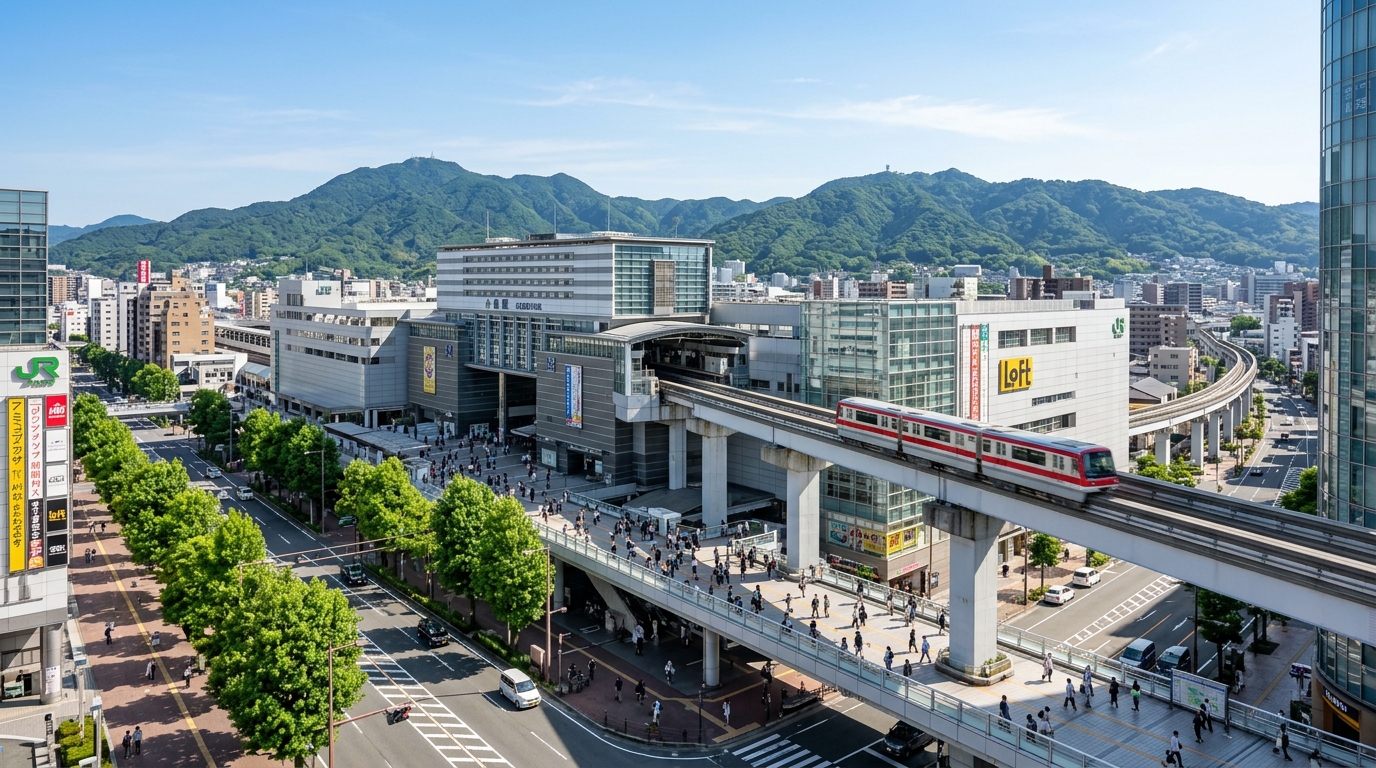
On November 24, 2026, the first floor of Tanga Market Ichibankan (旦過市場いちばん館), a commercial facility marking the first phase of the redevelopment project for Tanga Market (旦過市場)—long cherished as the kitchen of Kitakyushu citizens—officially opened. Around JR Kokura Station (JR小倉駅), the gateway to Kyushu, a phased reconstruction of the Tanga district leading up to the end of fiscal year 2030 overlaps with a long-term urban regeneration vision looking ahead to 2043, quietly rewriting the cityscape and the underlying assumptions of the local real estate market.
To state the conclusion upfront, Kokura Kita Ward (小倉北区) in Kitakyushu City, Fukuoka Prefecture, keeps land prices at a fraction of those in central Fukuoka City, making it an area where buyers can easily secure a "spacious home close to the station and urban amenities" on the same housing budget. On the other hand, the flatlands where redevelopment is concentrated are designated with a flood hazard of 5 to 10 meters in maximum inundation depth, while hillside residential areas require living with steep slopes and car maintenance costs. Therefore, it is essential to carefully evaluate the conditions behind the affordable prices.
In this article, based on the latest actual figures compiled by our company from the Ministry of Land, Infrastructure, Transport and Tourism's (MLIT / 国土交通省) real estate transaction data as well as public data, we examine how the redevelopment around Kokura Station will impact asset values in 2030 and the selection of detached houses and land in the surrounding area, looking at both the positives and the trade-offs to watch out for.
1. Redevelopment Schedule Around Kokura Station and Urban Changes Toward 2030
To understand the redevelopment around Kokura Station, it is important to view it not as a one-off commercial building construction, but as a long-term project linking "disaster prevention, university integration, and city-center renewal." Organizing the major plans and target years moving forward from the near term into the 2030s reveals the trajectory of the city's transformation.
| Plan / Project Name | Main Location & Details | Target Year / Schedule |
|---|---|---|
| Tanga Market Ichibankan (Phase 1 of Tanga District Redevelopment) | Uomachi 4-chome, Kokura Kita Ward. A 4-story above-ground commercial building with market functions on 1F, dining floor on 2F, and parking on 3F & 4F | Nov 24, 2026 (1F opening) / Spring 2027 (2F dining floor scheduled) |
| The University of Kitakyushu "Faculty of Information Innovation" Tanga Campus | A 5-story above-ground complex within Tanga Market (1F market, 2F–5F university-industry collaboration space, capacity: 472 students) | April 2027 (Faculty opens, initially using Kitagata Campus) / March 2028 (New facility completion scheduled) |
| Kamitake River & Tanga District Redevelopment Project (Overall Completion) | Phased reconstruction of the entire market area, riverfront embankment improvements, flood control measures, and land readjustment of adjacent areas | End of FY 2030 (Projected overall project completion) |
| Uomachi 3-chome 2-ban District Category-1 Urban Redevelopment Project | A corner of Uomachi Gintengai (approx. 0.37 ha). Mixed-use renewal of commercial, business, and residential spaces with improved disaster resilience (plan reorganization stage) | Added to Kitakyushu City Location Normalization Plan measures (Revised March 2026) |
| Kitakyushu 2043 "Kokura Boost" (Draft Concept) | Covering roughly a 1 km radius around Kokura Station: station plaza reorganization, lane reduction on Heiwa-dori, hotel attraction, consideration of city hall reconstruction, etc. | Formal strategy scheduled for FY 2026 / 2043 Target |
Of particular note is that following the opening of Tanga Market Ichibankan's first floor today, the newly established Faculty of Information Innovation at The University of Kitakyushu (北九州市立大学) will move into the Tanga district in April 2027. Although the new campus is scheduled for completion in March 2028, a new flow of people—students aiming to become digital talent and IT companies—will be added to the traditional "tourism and shopping" market.
Furthermore, in the "Kitakyushu 2043: Strategy for Next-Generation Urban Development and Investment" draft announced by the city in July 2026, central Kokura is positioned as a "Hub of Creation," proposing the expansion of pedestrian spaces around Kokura Station and support for rebuilding into next-generation offices. However, this 2043 vision is still at the framework stage to attract private investment, and individual project costs and construction start dates have not yet been finalized. When considering a home purchase on a 2030 timeline, it is wise to factor in the concrete disaster-prevention and educational developments progressing in the Tanga district between FY 2026 and FY 2030 as certain changes, while calmly observing the long-term vision without overly pricing it in prematurely.
2. Real Estate Market in Kokura Kita Ward and Price Gaps with Fukuoka City & Neighboring Areas
While redevelopment expectations draw attention, looking at actual transaction data reveals that Kokura Kita Ward's real estate market has two faces: an "affordable price range" and "polarization in the city center." According to all 2,439 transaction records around Kokura Station (Kokura Kita Ward, Kitakyushu City, Fukuoka Prefecture) from 2021 to 2026 (compiled based on MLIT's Real Estate Information Library), the average transaction price is approximately 31.27 million yen, whereas the median transaction price is 15 million yen. The data includes a wide range of properties from a minimum of 50,000 yen to a maximum of 1.8 billion yen, with an overall average unit price of about 95,462 yen/m² (approx. 95,000 yen/m²). The more than twofold gap between the average and the median is because a small number of high-priced condominiums and commercial land near the station push up the average.
To grasp recent market trends more accurately, let's look at the quarterly trends by property type compiled by our company from MLIT's Real Estate Information Library.
| Target Category (Q1 2026) | Quarterly Transactions | Median Unit Price (per m²) | Median Transaction Price | YoY Change (Median Unit Price/m²) |
|---|---|---|---|---|
| Pre-owned Condominiums, etc. | 36 | Approx. 169,000 yen/m² | 12.0 million yen | -14.2% |
| Residential Land (Land only) | 12 | Approx. 93,000 yen/m² | 23.0 million yen | +20.8% |
| Residential Land (Land & Building) | 33 | Approx. 126,000 yen/m² | 22.0 million yen | +2.7% |
Source: Quarterly compilation by our company of MLIT Real Estate Information Library transaction data (Kokura Kita Ward, Kitakyushu City, Q1 2026)
The median unit price for pre-owned condominiums rose from about 158,000 yen/m² in Q2 2024 to 200,000 yen/m² in Q4 2025, before temporarily settling at about 169,000 yen/m² (-14.2% YoY) across 36 transactions in Q1 2026. Meanwhile, the median for residential land with buildings remained firm, moving from about 122,000 yen/m² in Q1 2025 to about 126,000 yen/m² in Q1 2026 (+2.7% YoY, median transaction price 22.0 million yen). Land-only transactions, though numbering only 12, also showed an upward trend at +20.8% YoY (approx. 93,000 yen/m²).
Compared to other major areas in Fukuoka Prefecture, the uniqueness of this price level stands out. According to a private land price survey (by SUUMO), Chuo Ward in Fukuoka City averages 1.244 million yen per tsubo (approx. 3.3 m²), Hakata Ward averages 1.03 million yen per tsubo, and even the more suburban Higashi Ward in Fukuoka City averages 478,000 yen per tsubo. In contrast, Kokura Kita Ward is 256,000 yen per tsubo (Kokura Minami Ward is 202,000 yen per tsubo, and Yahatanishi Ward is 173,000 yen per tsubo). Furthermore, in the 2026 (Reiwa 8) Land Price Survey published by Kitakyushu City, the citywide average for residential land was 63,400 yen/m² (+1.3% YoY) and commercial land was 207,100 yen/m² (+3.2% YoY), showing a gentle upward trend. Despite being the central ward of a government-designated city, the hurdle for acquiring land is significantly lower than in Fukuoka City.
3. Pros of Kokura Kita Ward: Living Comfort Born from Industrial Concentration and Terrain
Behind Kokura Kita Ward's lower prices compared to Fukuoka City lie differences in urban scale and population dynamics, but looking at it from a resident's perspective reveals historical and industrial strengths that go beyond "mere cheapness."
The first factor is its solid industrial base and recent corporate attraction. Led by TOTO, which is headquartered in Nakashima, Kokura Kita Ward, Kitakyushu City is a major hub for manufacturing companies. In recent years, digital companies have also been moving into central Kokura through the IT corporate attraction network "IT Scrum KitaQ." Additionally, green energy investments such as offshore wind power in Hibikinada are underway. According to Kitakyushu City's FY 2025 financial report, capital investment commitments by incoming companies reached 777.7 billion yen, and the number of U-turn and I-turn workers reached 298—both hitting record highs for three consecutive years—while net migration turned positive for the second straight year (+443 people). Having diverse workplaces without over-relying on a single company or industry underpins real-demand housing needs.
The second point to understand is the formation of Kokura's cityscape and its topographical diversity. According to the Geospatial Information Authority of Japan's (GSI / 国土地理院) land condition survey, from the south side of Kokura Castle ruins between the Murasaki River (紫川) and Itabitsu River (板櫃川), a flat fluvial terrace (Kokura Plateau) with an elevation of around 10 meters, formed roughly 100,000 years ago, spreads out. Behind it, hills with elevations of 50 to 100 meters composed of Mesozoic Cretaceous sedimentary and volcanic rocks extend. In other words, flat commercial and residential urban areas near the station and shopping streets compactly coexist with hillside residential areas that have relatively firm ground.
This combination of topography and price levels directly translates into living comfort. For example, the zoning around Kokura Station is Commercial Zone (building coverage ratio 80%, floor area ratio 400%), offering high urban convenience with 47 medical institutions confirmed within the surrounding radius. Yet, in residential areas just a short distance away, it is not uncommon to find detached houses on roughly 200 m² of land trading in the 20 to 35 million yen range. Seeking the same floor area and lot size in Fukuoka City often forces a long commute from the suburbs, whereas in Kokura Kita Ward, it is a major attraction that one can realistically balance "living close to work" with a "spacious living room, garden, and parking."
Municipal support is also a tailwind for end-user buyers. When young households (aged 39 or under) or child-rearing households (with children under 18) moving in from outside the city acquire quality housing in designated urban areas, the "Sumunara Kitakyushu Migration Promotion Project (Young & Child-Rearing Homeownership Support Menu)" provides a subsidy of 150,000 yen per household member, up to a maximum of 500,000 yen (*subject to annual budget and unit limits). Additionally, Kitakyushu City's "Child Medical Expense Subsidy System" has no income limit and covers children until the first March 31 after they turn 18. There is no out-of-pocket cost for hospitalization or pharmacies, and outpatient visits have a monthly cap per medical institution (free under age 3, 600 yen for preschoolers, 1,200 yen for elementary school students, and 1,600 yen for junior high school students and older), making it easy to plan for medical expenses during child-rearing years.
4. Things to Watch Out For to Avoid Regret: Trade-Offs of Hazards, Slopes, and Hidden Costs
On the other hand, choosing a home in Kokura Kita Ward comes with "underlying conditions behind the price gap." To avoid regret after purchasing, it is essential to factor in the following three trade-offs in advance.
1. Flood Hazards in the Murasaki & Kamitake River Basins and Terrain-Specific Risks
Checking site data around Kokura Station shows that while landslide risk is rated "none," flood hazard is rated "at risk (Maximum Inundation Depth Rank 4: 5–10m)." The flat central urban area of Kokura Kita Ward includes alluvial lowlands formed by the Murasaki, Kamitake, and Itabitsu rivers, and the flood inundation assumption zones published by Kitakyushu City include parts of Otemachi, Uomachi, Kyomachi, Katano, and Shirogane. Furthermore, in June 2026, the city newly designated "Inland Water (Rainwater) Flood Inundation Assumption Zones" and also publishes liquefaction hazard distribution maps assuming the Kokura Higashi Fault. When considering land or a detached house, designing to secure first-floor elevation and thoroughly checking hazard maps are mandatory.
2. The "Hidden Cost" of Commuting to Hakata and Car Maintenance in Hilly Areas
Kokura Station is a major terminal where the Sanyo Shinkansen, JR Kagoshima Main Line, Nippo Main Line, Hitahikosan Line, and Kitakyushu Monorail intersect (note that daily average passenger counts were not included in the API data retrieved for this article). However, if you assume a lifestyle of commuting to Fukuoka City (Hakata Station) for work or school, the burden of transportation costs cannot be ignored. A 1-month Shinkansen commuter pass ("FREX") between Kokura and Hakata costs 66,380 yen, and even a 1-month conventional line (Kagoshima Main Line) pass costs 44,600 yen. If this exceeds your company's commuting allowance cap, the money saved on housing prices could be offset by monthly transportation costs, so advance calculation based on office attendance frequency and allowance rules is necessary.
Moreover, if you choose hillside residential areas like Akasaka, the foot of Mt. Adachi, or around Tomino to avoid flood risks, steep slopes become part of daily movement. Shopping on foot or by bicycle can easily become a burden, and many areas practically require owning nearly one car per person. It is important to compare total housing costs, including vehicle purchase, parking fees, and insurance.
3. Differences in Liquidity Upon Sale by Property Type and Location
Attention must also be paid to market depth. Looking at Q1 2026 transaction counts, there were 36 transactions for pre-owned condominiums, whereas land-only transactions were limited to 12. Furthermore, as seen in the quarterly fluctuations of the median unit price for pre-owned condominiums between 128,000 and 200,000 yen/m², price volatility is large depending on building age, distance from the station, and management condition. Detached houses in hilly areas far from stations or monorail lines, as well as irregularly shaped lots, tend to take longer to find a buyer when relocating or selling in the future. Therefore, it is reassuring to maintain an exit-strategy perspective: not just "budget at purchase," but "whether the next household will want to live in this location when you sell."
5. Ripple Effects of Redevelopment on Detached House and Land Selection in Kokura Kita Ward
The redevelopment around the station and Tanga Market will not only increase the convenience of commercial facilities, but also gradually ripple out to surrounding residential areas and the detached house/land market.
The biggest point is the "increase in young singles, students, and IT-related talent" flowing into the Tanga Market area and central Kokura. With the opening of The University of Kitakyushu's Faculty of Information Innovation in April 2027, the completion of the Tanga Campus in 2028, and the concentration of companies in central offices through "IT Scrum KitaQ," demand for single-person rentals and compact condominiums will first rise around JR Kokura Station and Monorail Heiwadori and Tanga stations.
As a result, family home-buying choices will broaden. In the central Commercial Zone (building coverage ratio 80%, floor area ratio 400%), competition with condominium sites, offices, and commercial uses is fierce, leaving limited quiet land suitable for detached houses. Consequently, real-demand detached house and land buyers will likely gravitate toward "Category-1 Residential Zones and Category-1 Medium-to-High-Rise Exclusive Residential Zones within 1 to 3 km of the station," where urban functions within a 10–15 minute walk of the station (shopping, medical care, Shinkansen access) can be used daily by monorail, bicycle, or bus.
Specifically, a few monorail stops south of Kokura Station (toward Kawaraguchi-Mihagino, Katano, and Jono), the Itozu and Otemachi areas west across the Murasaki River, and the Sunatsu, Ashihara, and Tomino areas to the east will serve as receiving areas where residents can enjoy the benefits of central redevelopment while securing a calm living environment in residentially zoned districts.
If you are actually planning to build a detached house from land, organizing the transaction unit prices and hazards of your target address using the free membership registration (area research save feature) on "Mekiki Research" (物件目利きリサーチ), and then using the Pro plan's "AI Architecture Simulator" to test 2D/3D floor plans, summer/winter solstice sunlight simulations, and rough total budget estimates in advance, will help you concretely grasp the balance between site conditions and construction costs (*not applicable for income/yield calculations or formal quotes).
6. Area-by-Area Checkpoints: How to Evaluate Flatlands, Educational Areas, and Hillside Residential Areas
Even within Kokura Kita Ward, the character of the neighborhood and market prices vary greatly by district. Organizing the top districts by transaction volume in our data alongside Q1 2026 transaction samples makes the characteristics of each area clear.
| District (Kokura Kita Ward) | Property Type / Example Main Zoning | Market & Transaction Characteristics Based on Actual Data | Home-Buying Checkpoints |
|---|---|---|---|
| Otemachi & Katano | Pre-owned condominiums, etc. (Top transaction volume) | Otemachi: 26 cases, median approx. 284,000 yen/m²; Katano: 13 cases, median approx. 187,000 yen/m² | Flat terrain, close to hospitals, city offices, and commercial facilities. Check inundation assumption zones around the Murasaki and Kamitake rivers at the street-number level |
| Kami-Itozu, Shimo-Itozu & Itabitsu-machi | Pre-owned condos & detached houses (Category-1 Medium-to-High-Rise Exclusive Residential Zone, etc.) | Kami-Itozu: approx. 213,000 yen/m²; Shimo-Itozu: approx. 158,000 yen/m². In Itabitsu-machi, a 185 m², 2001-built detached house traded for 18 million yen | Good living balance near greenery and commercial facilities. Check bus routes, arterial road traffic volume, and hazards along the Itabitsu River |
| Ashihara & Shimo-Tomino | Residential land (Land & Building) / Category-1 & Category-2 Residential Zones, etc. | Shimo-Tomino: 11 detached house cases, median approx. 188,000 yen/m². In Ashihara, a 205 m² 5LDK (built 2003) traded for 35 million yen, and a 50 m² 2LDK (built 1998) for 20 million yen | Residential area with easy access to Kokura Station and Sunatsu. Some lots have elevation differences, so check front road width and road frontage |
| Akasaka, Adachi & Atago | Detached houses, land, large condos (Category-1 Residential / Category-1 Medium-to-High-Rise, etc.) | In Akasaka, a 210 m² 4LDK (built 2025) traded for 28 million yen; in Atago, 430 m² of land for 52 million yen (120,000 yen/m²); in Adachi, a 155 m² pre-owned condo for 50 million yen | Close to parks and nature, easy to secure space, but walk the site day and night to verify slopes and car accessibility |
Source: MLIT Real Estate Information Library (Q1 2026 samples and quarterly compilation)
Note that in the system data retrieved for this article, the elementary and junior high school district fields for the Kokura Station area were unrecorded (null). Because Kokura Kita Ward has numerous school districts—including Kokura Chuo, Nishi-Kokura, Adachi, Kiyomizu, and Ashihara elementary schools—families with children should be sure to check Kitakyushu City's official school district list together with the evacuation information target areas for the Murasaki River basin (which are published by elementary school district).
7. Who Kokura Kita Ward Suits / Who Should Consider Carefully
Based on the data and living environment analysis so far, here is a summary of who is likely to fit well with home-buying in Kokura Kita Ward and who should compare options carefully.
Who Kokura Kita Ward Suits
- Families and dual-income households prioritizing spaciousness and station-front convenience on the same budget: Those who want to leverage land prices in the 200,000 yen/tsubo range to secure a spacious 4LDK–5LDK detached house or a large lot.
- Those with workplaces or bases within Kitakyushu City or along the Shinkansen line: Employees of major local companies like TOTO or central IT firms, or those who frequently take Shinkansen business trips toward Okayama, Hiroshima, or Tokyo.
- Those seeking a balance between child-rearing support and urban infrastructure: Those who want to live in an environment with department stores, markets, and medical institutions nearby while utilizing child medical expense subsidies up to age 18 and homeownership subsidies for incoming residents.
Who Should Consider Carefully
- Those who commute daily to Hakata Station or Tenjin and pay transportation costs out-of-pocket: Using the Shinkansen or conventional limited express daily can easily strain household finances with commuter passes (40,000–60,000+ yen/month), requiring a total cost comparison with Higashi Ward in Fukuoka City or the Munakata/Fukutsu areas.
- Flatland-oriented buyers who prioritize complete avoidance of disaster risks: Because flat commercial and lowland areas around the station overlap with inundation assumption zones, adjusting conditions—such as choosing a hillside (with slopes) or a middle-to-upper floor of a condominium—is essential.
- Those seeking short-term resale within a few years or high liquidity: Even pre-owned condominiums show quarterly unit price fluctuations, and land transaction volume is limited, making careful location selection that accounts for long-term residence or future rental/sale indispensable.
8. Summary
Around Kokura Station, starting with the opening of Tanga Market Ichibankan's first floor in November 2026, the opening of The University of Kitakyushu's new faculty in 2027, and the overall redevelopment of the Tanga district toward the end of FY 2030, moves to elevate the city center's appeal and disaster resilience are steadily progressing. Meanwhile, market data shows that the median transaction price remains at an accessible 15 million yen and the average unit price is about 95,000 yen/m², making the "living comfort" compared to Fukuoka City a major strength unique to Kokura Kita Ward.
However, clear trade-offs exist that should be factored in beforehand, such as the 5 to 10m maximum flood hazard in lowland areas, slopes and car costs in hillside areas, and commuter pass expenses when commuting to Hakata. Start by checking public data to see "which area, and what kind of disaster risks and conveniences you are willing to accept."
By registering for a free membership, you can pull the MLIT data used in this blog directly from your Claude or ChatGPT (via MCP integration). You can dig deeper into market trends and hazards for any address you are interested in while conversing with your own AI, so please make use of it to choose an area you are truly satisfied with.