
As condominium prices in central Tokyo soar past ¥100 million, interest in eastern Tokyo is surging among end-users who don't want to compromise on commuting access but want a slightly larger home or a detached house within the same budget. Among these areas, Sumida Ward (墨田区) stands out as a neighborhood that combines the livability of a traditional downtown (shitamachi) district with rapid access to central Tokyo, all while housing iconic landmarks like Tokyo Skytree (東京スカイツリー) and Ryogoku Kokugikan (両国国技館).
At the same time, Sumida Ward's geographical characteristics—being a lowland area sandwiched between the Arakawa River (荒川) and the Sumida River (隅田川)—and its historic urban fabric of densely packed wooden houses mean there are clear underlying reasons and trade-offs behind its relative affordability. Jumping in solely based on the apparent bargain could lead to unexpected gaps regarding flood risks, sunlight conditions, and building maintenance or reconstruction costs.
In this article, we use real estate transaction data and hazard information from the Ministry of Land, Infrastructure, Transport and Tourism (MLIT) to analyze Sumida Ward's market evaluation through its closed unit price trends, organizing both the "strengths" and "potential regrets" that homebuyers and investors should factor in beforehand.
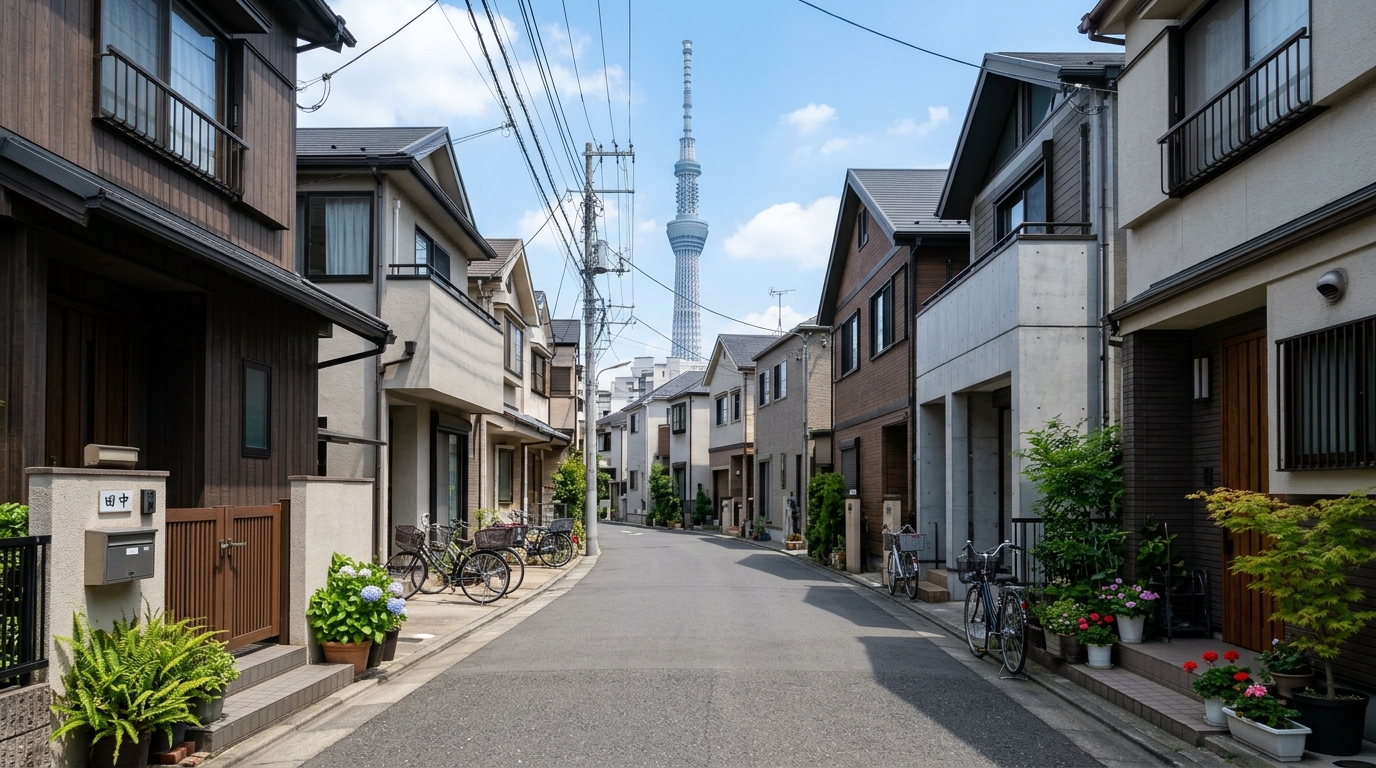
First, let's review an overview of Sumida Ward's real estate market, urban updates, and key living environment indicators.
| Item | Indicators & Latest Trends (as of 2026) |
|---|---|
| Transaction Volume & Market Price (2021–2026) | 7,715 transactions / Avg. Price: approx. ¥62.44 million / Median: ¥40 million / Avg. Unit Price: approx. ¥900,000/㎡ |
| Latest Unit Price by Property Type (2026Q1) | Pre-owned Condos, etc.: ¥1,040,000/㎡ (+6.7% YoY)<br>Residential Land (Land only): ¥870,000/㎡ (-27.5% YoY, low volume)<br>Residential Land (Land & Building): ¥950,000/㎡ (-8.7% YoY) |
| Major Redevelopment & Infrastructure | ・Tokyo Skytree Station (とうきょうスカイツリー駅) grade separation (elevated tracks for both directions completed Mar 2025, new station building opened Dec 2025, full completion scheduled FY2028)<br>・Tobu Hikifune Station (東武曳舟駅) Front District Type 1 Urban Redevelopment (urban planning decision Mar 2026, completion scheduled FY2032) |
| Living Environment & Hazards Around Benchmark | Zoning: Neighborhood Commercial Zone (BCR 80.0% / FAR 300.0%)<br>Flood Risk: Yes (Max inundation depth Rank 2: 0.5–3m) / Landslide Risk: None |
| Municipal Housing & Childcare Support | Sumida Housing Acquisition Interest Subsidy Program (up to ¥500,000), Fireproof Special Zone (不燃化特区) Grant (until end of Mar 2031), Global Warming Prevention Equipment Installation Grant (up to ¥500,000) |
Note: Transaction statistics and surrounding environment data are retrieved via MLIT API and Geospatial Information Authority of Japan (GSI) data for the benchmark area in Sumida Ward (around Oshiage [押上], Narihira [業平], Ishihara [石原], and Azumabashi [吾妻橋]). Quarterly trends are aggregated by our company from MLIT's "Real Estate Information Library" (不動産情報ライブラリ).
1. Evaluating Sumida Ward Through Its Real Estate Market and Unit Price Trends
In short, Sumida Ward is a market where pre-owned condominiums remain resilient, backed by strong end-user demand, while land and detached houses see limited transaction volume and wide variations in closed unit prices depending on individual site conditions.
Looking at the 2021–2026 transaction records (7,715 cases) around Sumida Ward aggregated on our data platform, the average transaction price is approx. ¥62.44 million, the median is ¥40 million, and the average unit price is approx. ¥900,000/㎡. Compared to central wards—for example, in a 2026 analysis—closed condo prices in Sumida Ward remain just over half (approx. 51%) of those in Chuo Ward (中央区). Despite being within roughly a 5 km straight-line radius of the Imperial Palace, it sits in a price range accessible to typical dual-income households.
Next, let's look at the quarterly trends by property type (2024Q2–2026Q1) aggregated by our company from MLIT's "Real Estate Information Library."
Pre-owned condominiums, etc. rose gradually from approx. ¥986,000/㎡ in 2024Q2 (299 cases, median price ¥35 million) to approx. ¥1,071,000/㎡ in 2025Q4 (340 cases, ¥40 million), and stood at ¥1,040,000/㎡ in the latest 2026Q1 (246 cases, ¥48 million), showing a resilient +6.7% YoY increase. While inventory stagnation is noticeable in the high-end central Tokyo market (over ¥100 million) across the Greater Tokyo Area as of autumn 2026, liquidity in surrounding wards that fit end-user budgets remains relatively healthy, reflecting strong demand for single-to-family condos in Sumida Ward.
In contrast, residential land (land only) in 2026Q1 was ¥870,000/㎡ (11 cases, median price ¥77 million), down -27.5% YoY, and residential land (land and building) was ¥950,000/㎡ (51 cases, median price ¥56 million), down -8.7% YoY. However, because quarterly land transactions are thin at just 5 to 30 cases (2025Q4 had only 5 cases, with a median of ¥1,500,000/㎡ and ¥140 million), it is important to note that figures swing significantly depending on whether a quarter saw larger commercial-adjacent plots or smaller residential plots.
2. Strengths of Sumida Ward: Central Mobility and a Craftsmanship Hub's Lifestyle
Sumida Ward's greatest appeal lies in offering overwhelming commuting access to Otemachi, Tokyo, and Shibuya, alongside the living infrastructure and municipal support of a historic "manufacturing town," all at a realistic budget.
In terms of transit, from Oshiage Station—one of the nearest stations to the benchmark point, served by Keisei Electric Railway, Toei Asakusa Line, Tokyo Metro Hanzomon Line, and Tobu Skytree Line—the Hanzomon Line reaches Otemachi Station directly in about 14 minutes for an IC fare of ¥209. (Note: Station passenger counts are not included in the environmental dataset retrieved for this report, but it functions as a major multi-line hub.) Additionally, Kinshicho Station (錦糸町駅) in the south reaches Tokyo Station in about 8 minutes via the JR Sobu Line Rapid, providing a rail network that makes it easy to reach central Tokyo, Haneda, and Narita airports alike.
Tracing the town's origins, Sumida Ward's canal network was built during the Edo period through Tokugawa Ieyasu's flood control and water utilization projects, fostering local industries such as roof tile production using riverbed clay. From the Meiji era onward, it developed into a major cluster of modern light industry. Even today, it boasts the second-largest number of factories among Tokyo's 23 wards, with over 2,000 workshops thriving as a "town of craftsmanship." As represented by the regional brand strategy "Sumida Modern," artisan skills coexist with new creators' sensibilities. Despite being a major consumption and tourist destination, daily necessities, eateries, and shopping streets blend seamlessly into everyday life.
Looking at actual living environment data, the benchmark area falls within the school districts of Sotode Elementary School (外手小学校) and Sumida Junior High School (墨田中学校), with 33 medical institutions confirmed nearby, including clinics like Adachi Clinic and Kodama Internal Medicine. Furthermore, the ward's generous housing support programs should not be overlooked:
- Sumida Housing Acquisition Interest Subsidy Program: For households with children junior high age or younger, or couples both under 40, the ward subsidizes mortgage interest up to ¥100,000 per year for 5 years (up to ¥500,000). It can also be combined with interest rate reductions under the Japan Housing Finance Agency's "Flat 35 Regional Cooperation Type (Childcare Support)."
- Global Warming Prevention Equipment Installation Grant: Subsidizes up to ¥500,000 per building for solar power generation, insulation retrofits, etc. From FY2026 (Reiwa 8), the subsidy rate for security-spec parcel boxes was raised to 50% of construction costs, and installations in newly built homes were added to eligibility.
3. Ongoing Redevelopment and Urban Updates: Changes Toward the 2030s in Oshiage & Hikifune
In northern Sumida Ward, large-scale urban renewal looking ahead to FY2028–2032 is steadily progressing, centered on eliminating longstanding railway crossings and improving disaster resilience.
Changes in daily life are already visible with the "Tokyo Skytree Station Vicinity Continuous Grade Separation Project." In March 2025, elevated tracks for both directions were completed, eliminating the Sakurabashi-dori Avenue crossing, and on December 7, 2025, the new station building (New East Exit ticket gate) and new outbound platform opened. North-south movement previously divided by the railway is now smooth, and toward full project completion in FY2028, utilization of under-track spaces and expansion of Tokyo Solamachi are also under consideration. Furthermore, Tobu Railway and partners are advancing urban development in the Mukojima 1-chome and Oshiage 1-chome areas around Skytree, aiming to establish a redevelopment preparatory association in FY2026 with hotel and residential projects in mind.
Just to the north, the "Tobu Hikifune Station Front District Type 1 Urban Redevelopment Project" has also gained major momentum. An urban planning decision was made on March 25, 2026, and on April 27, 2026, Hankyu Hanshin Properties and U.D. Consultants were selected as business partners for the Urban Renaissance Agency (UR). This "plaza-style redevelopment" on approx. 1.7 ha in Higashi-Mukojima 2-chome will feature a 14-story mixed-use building with approx. 240 residential units and retail, alongside an approx. 2,250 ㎡ transit plaza and an approx. 3,300–4,000 ㎡ urban planning park. Construction is scheduled to begin in FY2029, with completion in FY2032.
In addition, the Kyojima (京島) and Kanegafuchi (鐘ヶ淵) districts remain designated as "Fireproof Special Zones" until March 31, 2031. From April 2026, grant amounts for fireproofing, seismic retrofitting, and demolition of aging buildings were significantly expanded across the ward and emergency response districts. Through these public-private updates, the town's disaster resilience, sidewalks, and park environments are being upgraded step by step.
4. Potential Regrets to Watch Out For: Hazard, Ground, and Living Environment Trade-offs
While offering an excellent balance of price and location, buying a home in Sumida Ward requires factoring in two key premises: "flood hazards and soft ground" and "building density from mixed-use zoning."
The first trade-off is topography and disaster risk. Sumida Ward sits in the "Koto Delta Zone" between the Arakawa River to the east and the Sumida River to the west, and the entire ward is classified as relatively young "alluvial lowland." Elevation within the ward reaches only about 4m at its highest and drops to -1.2m at its lowest, including zero-meter elevation zones (below sea level). Hazard data at the benchmark point also indicates Flood Risk: "Yes" (Max inundation depth Rank 2: 0.5–3m), while landslide risk is none.
In a worst-case flood where the Arakawa River levee breaches, most of the ward faces inundation risk, and it has been pointed out that water could take over two weeks to recede; consequently, the 5 Koto Wards including Sumida are studying wide-area evacuation plans. Moreover, alluvial lowlands tend to amplify seismic shaking during earthquakes. When building a detached house from land, budgeting for ground surveys and piling/ground improvement is essential, as is designing electrical panels, water heaters, and storage batteries at elevated heights.
The second trade-off is the living environment unique to a shitamachi mixed residential-industrial area. The benchmark point is zoned as a Neighborhood Commercial Zone (BCR 80.0%, FAR 300.0%), and 2026Q1 transaction samples also show a mix of Commercial Zones in Azumabashi (FAR 500%, BCR 80%) and Neighborhood Commercial / Quasi-Industrial Zones in Ishihara. In such areas, small factories, commercial buildings, 3-story detached houses, and condos stand close together. Even at the same price point, it is difficult to get the "quietness, spacious yard, and open southern exposure" of a suburban Category 1 Low-Rise Exclusive Residential Zone. Additionally, parts of the northern area still have narrow roads and dead-end streets, so setback requirements during rebuilding and higher manual demolition costs are factors to verify beforehand.
5. Living Costs and Liquidity Noticed After Moving In: Parking, Daycare, and Resale
In daily life, differences tend to emerge in "parking costs," "daycare competition," and "ease of selling (liquidity) by property type" when you eventually part with the home.
First, if you own a car, monthly parking maintenance costs weigh heavily. Looking at monthly parking rates around Oshiage, average rents generally run around ¥19,000–¥23,000 per month (flat surface: approx. ¥18,000–¥27,000; mechanical: approx. ¥25,000–¥27,000), but spaces accommodating large cars or SUVs account for only approx. 12% of the total. In compact detached houses with built-in garages, first-floor living space is sacrificed, so depending on your lifestyle, opting not to own a car and relying on car-sharing may make it easier to secure spaciousness at home.
For child-rearing households, the daycare environment is another critical point. Amid continued net in-migration to Sumida Ward, data compiled as of April 1, 2026 shows the 1-year-old class daycare enrollment rate at 85.9% (compared to the 23-ward average of 90.3%), with 17 waitlisted children (up from 5 the previous year), making it slightly more competitive than the 23-ward average. It is important to work backward from your move-in timing and daycare application schedule together.
Liquidity for future resale also warrants attention. As noted earlier, pre-owned condos form a deep market of 246–352 transactions per quarter, whereas land (5–30 cases) and detached houses (51–92 cases) have limited circulation. Depending on road frontage, lot width, and hazard inundation depth rank, the pool of prospective buyers may narrow, taking longer to close at your desired price. Incidentally, Sumida Ward's financial capability index in the FY2024 settlement was 0.42. While supported by Special Ward Fiscal Adjustment Grants (31.5% of revenue), its FY2026 initial budget reached a record-high approx. ¥155.9 billion to advance education and disaster prevention investments. Although administrative standards are maintained through the inter-ward fiscal adjustment system, it is wise to keep an eye on future public facility renewals and subsidy continuations.
6. Area Characteristics in Sumida Ward and Checkpoints for Choosing Land or Detached Houses
Even within Sumida Ward, price levels and neighborhood character differ between the south (Ryogoku, Kinshicho, Midori [緑], Kotobashi [江東橋]) and the north (Oshiage, Mukojima, Higashi-Mukojima, Kyojima). When choosing land or a detached house, checking three points—"disaster resilience, sunlight, and regulatory requirements"—is indispensable.
Looking at the top 5 districts by transaction volume for pre-owned condos aggregated by our company from MLIT data, unit price differences by area become clear.
| District | Aggregated Transactions | Median Unit Price/㎡ | Key Neighborhood Characteristics |
|---|---|---|---|
| Higashi-Mukojima | 134 cases | ¥1,000,000/㎡ | Around Hikifune & Higashi-Mukojima stations. Residential area close to redevelopment and shitamachi shopping streets |
| Mukojima | 117 cases | ¥1,050,000/㎡ | Close to the Sumida River and Skytree; a mix of historic geisha district charm and new condos |
| Midori | 105 cases | ¥1,120,000/㎡ | Between Ryogoku and Kikukawa. Close to Toei & JR lines, with orderly grid-like blocks |
| Kotobashi | 85 cases | ¥1,160,000/㎡ | South side of Kinshicho Station. Central-adjacent hub with high commercial concentration and transit convenience |
| Ishihara | 72 cases | ¥1,080,000/㎡ | Ryogoku & Honjo area. In 2026Q1, a 2LDK (60㎡, built 1991) traded for ¥65 million |
Source: Aggregated by our company from MLIT's Real Estate Information Library transaction data.
The southern areas around Midori, Kotobashi, Ishihara, and Azumabashi trace their roots to orderly Edo-period blocks and command slightly higher unit prices due to rail convenience and commercial amenities. Meanwhile, northern areas like Higashi-Mukojima, Kyojima, and Yahiro (八広) offer lower unit prices and broader options for detached house plots or rebuilding, though verifying road frontage and Fireproof Special Zone rules becomes even more important.
When considering land or a detached house in Sumida Ward, keeping the following three checkpoints in mind will provide peace of mind:
- Balance between hazards and building height: In 0.5–3m inundation zones, plan floor layouts and disaster measures together—such as raising the foundation, placing wet areas on the 2nd floor or above, and elevating electrical equipment.
- Zoning and winter solstice sunlight simulation: In Neighborhood Commercial or Quasi-Industrial Zones with 80% BCR and 300% FAR, 3-story buildings easily go up on neighboring lots, making 1st-floor living rooms prone to poor winter sunlight. Adopting a 2nd-floor living room or utilizing voids and clerestory windows will shape daily comfort.
- Advance verification of subsidies and documents: The "Sumida Housing Acquisition Interest Subsidy Program" requires checking documents like the inspection certificate, while "Fireproof Special Zone" and "Global Warming Prevention Equipment Installation" grants require prior application before contracting or starting construction.
Once you find an address of interest, using the free membership features of "Mekiki Research" (物件目利きリサーチ) to save and compare local transaction unit price trends and hazard information is an efficient first step. Furthermore, when concretely considering building a detached house on a compact or dense plot, utilizing the Pro plan's "AI Architecture Simulator" allows you to check 2D floor plans, 3D models, summer/winter solstice sunlight simulations, and rough total budget estimates all in one place.
7. Who Sumida Ward Suits / Who Should Consider Carefully
Based on the market data and living environment characteristics above, here is a summary of who fits Sumida Ward well and who should compare carefully.
Who Sumida Ward Suits
- Dual-income households and singles looking to keep commuting time and costs to central hubs like Otemachi, Tokyo, and Shibuya low, while expanding housing size or detached house options on the same budget.
- People drawn to shitamachi streetscapes where history and new culture blend, including local workshops, long-standing shopping streets, and Sumida Riverfront spaces.
- Buyers who can systematically utilize municipal support programs—such as interest subsidies and fireproofing/energy-saving grants—on schedule during their homebuilding process.
Who Should Consider Carefully
- Those who feel strong anxiety about terrain including zero-meter elevation zones or projected 0.5–3m flood inundation, and want elevated plateau ground as an absolute condition.
- Those who prioritize a quiet low-rise residential neighborhood with a spacious yard, multiple flat parking spaces, and open southern sunlight above all else.
- Those who count on guaranteed daycare entry from the 1-year-old class and want to avoid waitlist risk as much as possible (requires early daycare planning and comparison with other wards).
8. Summary
Sumida Ward's real estate market sits at an accessible level—with a 2021–2026 median transaction price of ¥40 million and average unit price of approx. ¥900,000/㎡—yet remains underpinned by solid end-user demand, particularly for pre-owned condos. Behind this lies transit convenience within 5 km of central Tokyo, the living infrastructure of a manufacturing town, and expectations for urban renewal toward the 2030s, such as the elevation of Tokyo Skytree Station and the plaza-style redevelopment in front of Tobu Hikifune Station.
On the other hand, objectively assessing the trade-offs behind the price—such as flood hazards, alluvial lowland terrain, sunlight and compact-lot constraints from mixed zoning, 1-year-old daycare competition, and parking costs—is the key to preventing regrets. Compare market data with on-site sunlight and neighborhood atmosphere to find a block that aligns with your priorities.
Additionally, by registering as a free member of "Mekiki Research," you can pull the MLIT data used in this blog directly from your Claude or ChatGPT (via MCP integration). If you want to explore local market prices and hazards for an address of interest while conversing with your own AI assistant, be sure to take advantage of it.
Check the latest land prices and hazard information for Sumida Ward, Tokyo on Mekiki Research 👉