
Kanagawa Ward (神奈川区) in Yokohama City (横浜市), Kanagawa Prefecture (神奈川県), borders the northern side of the major terminal Yokohama Station (横浜駅) and offers a diverse landscape ranging from bayside business and commercial districts to quiet inland residential neighborhoods. As of November 2026, its estimated population stands at 254,444 (+1,996 year-over-year), continuing an upward trend. Alongside strong demand for condominiums near the city center, there is steady interest—particularly among families—in detached houses and land for custom-built homes.
However, even within Kanagawa Ward, transaction unit prices and ground conditions vary significantly depending on the area: urban zones within walking distance of Yokohama Station, highly convenient neighborhoods around Higashi-Kanagawa (東神奈川) and Tammachi (反町), and hilly or plateau areas such as Hazawa-Minami (羽沢南) and Mitsuzawa (三ツ沢). Understanding the topography and infrastructure behind these price differences is the first step toward choosing a home without regrets.
Based on real estate transaction data from the Ministry of Land, Infrastructure, Transport and Tourism (MLIT / 国土交通省), hazard information, and recent redevelopment and municipal support programs, this article outlines the current market in Kanagawa Ward and key perspectives on living environments and architectural planning when considering land or a detached house.
| Indicator / Item | Latest Status & Figures for Kanagawa Ward, Yokohama | Notes / Source |
|---|---|---|
| Estimated Population & Households | 254,444 people / 137,506 households | As of November 1, 2026 (+1,996 YoY) |
| 2026 Official Land Price (Residential) | Avg. approx. ¥1.10 million/tsubo (+5.1% YoY) | Average of 34 sites in the ward (Yokohama City overall: +4.3%) |
| Transaction Price (2021–2026) | Avg. approx. ¥52.53 million / Median approx. ¥41.00 million | 5,715 transactions; avg. unit price approx. ¥375,000/㎡ (MLIT data) |
| Pre-owned Condominiums, etc. (2026Q1) | Median unit price ¥800,000/㎡ (+11.1% YoY) | 173 transactions; median price ¥49.00 million |
| Residential Land (Land & Building, 2026Q1) | Median unit price approx. ¥588,000/㎡ (-10.9% YoY) | 89 transactions; median price ¥55.00 million |
| Residential Land (Land Only, 2026Q1) | Median unit price ¥330,000/㎡ (+6.5% YoY) | 2 transactions (*thin data in the latest quarter); median ¥43.00 million |
| Major Redevelopments & Trends | "THE YOKOHAMA FRONT" (completed 2024; association dissolved 2026)<br>"HAZAWA VALLEY (HAZAAR)" (phased opening from Oct 2024) | Station-front redevelopment in Tsuruyacho and mixed-use development at Hazawa Yokohama-Kokudai Station |
1. Real Estate Value in Kanagawa Ward and Price Balance with Neighboring Wards
Kanagawa Ward is valued for its balance between overwhelming convenience—being directly connected to central Yokohama Station—and calm inland residential areas. As a result, it maintains the third-highest land price level in the city, following neighboring Nishi Ward (西区) and Naka Ward (中区).
Comparing 2026 MLIT official land price (residential) data, Nishi Ward—home to Yokohama Station's West Exit and Minato Mirai (みなとみらい)—averages around ¥1.24 million/tsubo (+15.0% YoY), and Naka Ward—around Kannai (関内) and Motomachi (元町)—averages around ¥1.32 million/tsubo (+3.2% YoY). Kanagawa Ward sits at approximately ¥1.10 million/tsubo (+5.1% YoY), slightly above neighboring Tsurumi Ward (鶴見区) at approx. ¥1.02 million/tsubo (+4.2% YoY) and well above the Yokohama City residential average of approx. ¥879,000/tsubo (+4.3% YoY). Furthermore, in the 2026 prefectural land price survey (all-purpose average), Kanagawa Ward recorded approx. ¥811,000/㎡ (+6.98%), demonstrating stronger commercial and residential demand than Kohoku Ward (港北区, approx. ¥651,000/㎡) or Tsurumi Ward (approx. ¥389,000/㎡).
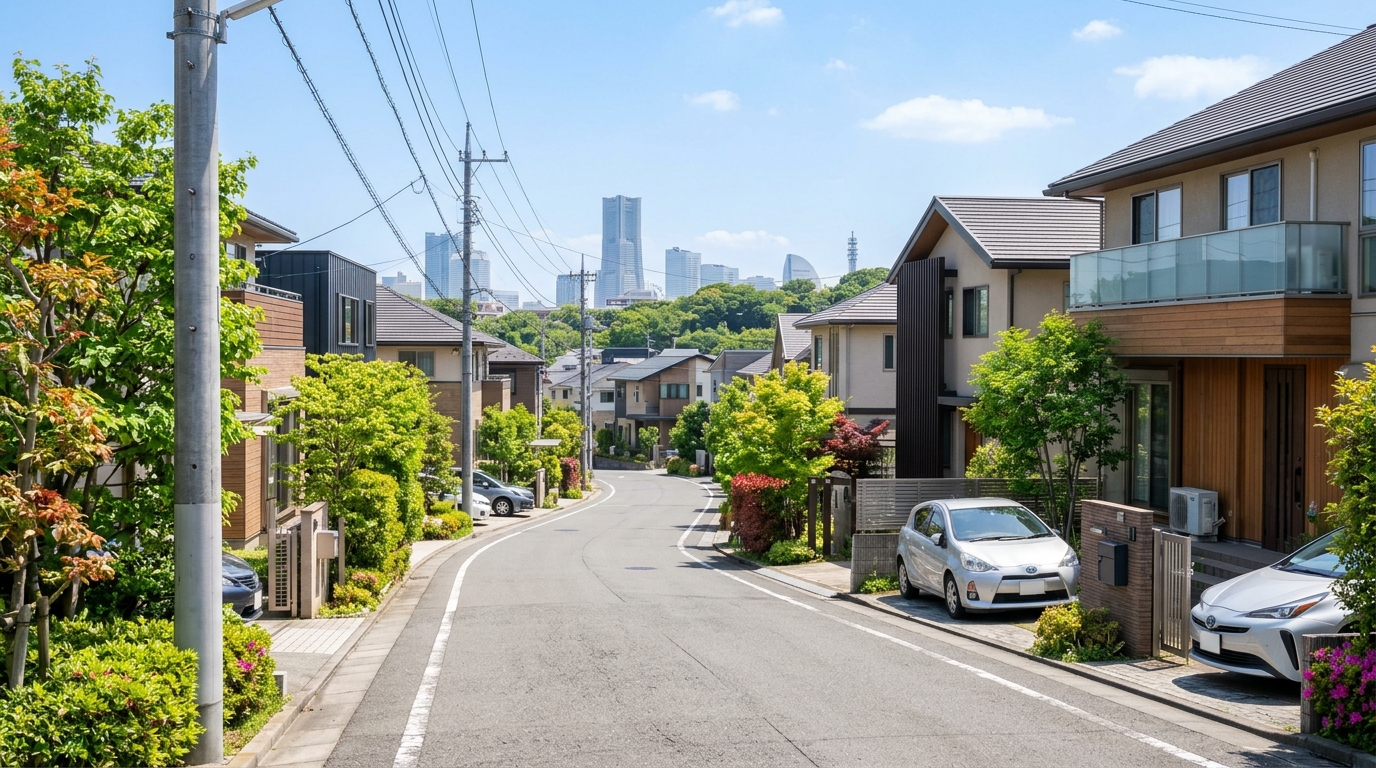
Why do such price differences and distinct characteristics emerge despite bordering Nishi Ward? A major reason is "diversity within the ward." Within its 23.73 ㎢ area, Kanagawa Ward encompasses everything from high-rise commercial and residential zones like Tsuruyacho (鶴屋町)—directly connected to Yokohama Station's Kita-Nishiguchi (きた西口)—to inland residential neighborhoods served by JR lines, the Keikyu Line (京急線), Tokyu Toyoko Line (東急東横線), Sotetsu Line (相鉄線), and the Municipal Subway Blue Line (市営地下鉄ブルーライン). Consequently, compared to looking at station-front condominiums in Nishi Ward on the same budget, inland residential areas in Kanagawa Ward—including those requiring a bus ride or involving slopes—offer a price balance that makes it easier to secure a plot for a detached house with generous floor space.
Looking at MLIT real estate transaction data from 2021 to 2026 (5,715 total transactions), the overall average transaction price in Kanagawa Ward is approx. ¥52.53 million, with a median of approx. ¥41.00 million and an average unit price of approx. ¥375,000/㎡. The data spans from a minimum of ¥350,000 to a maximum of ¥13 billion, reflecting a multifaceted market ranging from compact condominium units to detached houses and commercial/industrial land.
2. Reading Transaction Trends from Closing Unit Prices
While condominiums account for the majority of transactions in Kanagawa Ward, detached houses (land and building) also circulate steadily. In contrast, public transactions for vacant residential land (land only) fluctuate significantly in volume depending on the period.
Compiling MLIT Real Estate Information Library data on a quarterly basis from Q2 2024 (2024Q2) through Q1 2026 (2026Q1) reveals clear differences in market depth across property types.
| Quarter | Pre-owned Condos, etc.<br>Deals / Median Unit Price | Residential Land (Land & Building)<br>Deals / Median Unit Price | Residential Land (Land Only)<br>Deals / Median Unit Price |
|---|---|---|---|
| 2024Q2 | 153 / ¥833,000/㎡ | 76 / ¥474,000/㎡ | 18 / ¥390,000/㎡ |
| 2024Q3 | 184 / ¥714,000/㎡ | 90 / ¥496,000/㎡ | 37 / ¥260,000/㎡ |
| 2024Q4 | 185 / ¥686,000/㎡ | 89 / ¥476,000/㎡ | 28 / ¥340,000/㎡ |
| 2025Q1 | 208 / ¥720,000/㎡ | 101 / ¥660,000/㎡ | 25 / ¥310,000/㎡ |
| 2025Q2 | 221 / ¥693,000/㎡ | 133 / ¥533,000/㎡ | 16 / ¥390,000/㎡ |
| 2025Q3 | 220 / ¥778,000/㎡ | 129 / ¥482,000/㎡ | 32 / ¥260,000/㎡ |
| 2025Q4 | 216 / ¥686,000/㎡ | 112 / ¥550,000/㎡ | 15 / ¥390,000/㎡ |
| 2026Q1 | 173 / ¥800,000/㎡ (+11.1% YoY) | 89 / approx. ¥588,000/㎡ (-10.9% YoY) | 2 / ¥330,000/㎡ (+6.5% YoY) |
Source: Quarterly aggregation by our company based on MLIT Real Estate Information Library transaction data (unit: median price per ㎡).
Three key points stand out from the table above. First, pre-owned condominiums form a highly liquid market with 150 to over 220 transactions per quarter, reaching a median unit price of ¥800,000/㎡ in 2026Q1 (median price ¥49.00 million, +11.1% YoY). Individual samples from 2026Q1 show a 2018-built 3LDK (60㎡) in Aokicho's (青木町) commercial zone trading at approx. ¥70.00 million, and a 1997-built 3LDK (75㎡) in Izumicho's (泉町) neighborhood commercial zone also trading at approx. ¥70.00 million—demonstrating that even older buildings maintain high values if they are near stations and suited for families.
Second, "Residential Land (Land & Building)"—meaning detached house transactions—also maintains a steady volume of around 80 to 130 deals per quarter, with a 2026Q1 median unit price of approx. ¥588,000/㎡ (median price ¥55.00 million). The -10.9% YoY figure is largely a pullback from a temporary concentration of high-priced deals in 2025Q1 (¥660,000/㎡); compared to the ¥470,000–¥490,000/㎡ range in late 2024, the overall market remains resilient.
Third, the data requiring the most caution is "Residential Land (Land Only)." In 2026Q1, only 2 public transactions were recorded (¥330,000/㎡, median ¥43.00 million), which is noticeably thin compared to the 15–37 deals seen from 2024Q3 to 2025Q4 (registration time lags in statistical compilation also play a role). Because vacant plots for custom-built homes are inherently scarce on the open market, it is essential to evaluate not just the latest quarter, but also the past 1–2 years of transactions (ranging from ¥260,000 to ¥390,000/㎡), land-value conversions from land-and-building deals, and market rates in neighboring districts.
Looking at the top-transacting districts further highlights the stark price differences across the ward:
- Tsuruyacho (Pre-owned condos: 48 deals): Median unit price ¥2,333,000/㎡ (high-grade zone directly connected to Yokohama Station)
- Tammachi (Pre-owned condos: 36 deals): Median unit price ¥1,020,000/㎡ (popular residential/commercial mix along the Tokyu Toyoko Line)
- Nishi-Kanagawa (西神奈川) (Pre-owned condos: 41 deals): Median unit price ¥835,000/㎡ (convenient area around Higashi-Kanagawa and Higashi-Hakuraku stations)
- Koyasudori (子安通) (Pre-owned condos: 57 deals): Median unit price ¥714,000/㎡ (residential/semi-industrial mix along the Keikyu and JR lines)
- Hazawa-Minami (Residential land [land & building]: 38 deals): Median unit price ¥474,000/㎡ (detached house / emerging area around Hazawa Yokohama-Kokudai Station [羽沢横浜国大駅])
Thus, even within the same ward, the pricing structure between "Tsuruyacho, directly connected to Yokohama Station" and "Hazawa-Minami, where detached house transactions are active" is completely different.
3. History, Terrain, and Disaster Resilience: Plateaus vs. Coastal Areas
To understand the living environment and price gaps in Kanagawa Ward, it is essential to look at its historical origins and its three-tiered topography and ground conditions.
Kanagawa Ward functioned as a distribution hub called "Kanagawa-minato" (神奈川湊) from the Kamakura period and flourished during the Edo period as "Kanagawa-juku" (神奈川宿), the third post town along the Tokaido Fifty-three Stations (東海道五十三次). Even today, temples, shrines, and shopping streets along the old Tokaido remain around Aokicho and Kanagawa-honcho. In fact, the names "Kanagawa Prefecture" and "Kanagawa Ward" originate from this historic post town.
Geologically, the ward's terrain is broadly divided into three zones:
- Plateaus and Hills (Shimosueyoshi Plateau [下末吉台地], Mitsuzawa Plateau [三ッ沢台地], etc.): Plateaus composed of marine deposits formed during a marine transgression roughly 125,000 years ago, topped by the Kanto loam layer. Areas such as Mitsuzawa, Katakura (片倉), Kandaiji (神大寺), Shirahata (白幡), and Hazawa fall into this zone. While the ground is relatively stable, steep slopes and cliffs are common.
- Inland Valleys (Yato / 谷戸) and Lowlands: Dendritic lowlands carved into the plateaus by small rivers. Because eroded soil and humus from the plateaus have redeposited here, soft ground can be found in places, sometimes requiring ground improvement or piling work for detached house foundations.
- Coastal Lowlands and Reclaimed Land: Areas reclaimed seaward from the former coastline along the old Tokaido since the Edo period. This includes coastal factories and logistics hubs forming part of the Keihin Industrial Zone (京浜工業地帯), as well as the Portside District (ポートサイド地区) adjacent to Yokohama Station's East Exit. While flat and easy to navigate, these areas require attention to liquefaction, storm surges, and tsunami risks.
Checking point data around Higashi-Kanagawa Station (Lat 35.4771, Lng 139.6334), the zoning is "Neighborhood Commercial Zone" (building coverage ratio 80%, floor area ratio 300%). According to Geospatial Information Authority of Japan (GSI / 国土地理院) hazard data, flood risk is rated "None," whereas landslide risk (debris flow) is rated "Present." Because Yokohama's urban area is a complex mix of plateaus and lowlands, assuming that "a flat commercial area near a station is free from landslide risks" can be a costly mistake. Plots right next to railway tracks or near the edges of plateaus frequently fall within landslide warning zones, making site-specific hazard checks mandatory.
4. Pros of Building a Detached House in Kanagawa Ward: Transit Access and Living Comfort
When considering buying land or building a detached house in Kanagawa Ward, the biggest draws are its "high mobility as a multi-line transit hub" and "recent station-area developments and municipal support."
In terms of transit, led by JR Higashi-Kanagawa Station (東神奈川駅; Keihin-Tohoku and Yokohama lines, averaging 34,547 daily boardings in FY2024; *passenger count fields are not included in the public API), residents have easy access to Keikyu Higashi-Kanagawa Station (京急東神奈川駅, renamed from Nakakido Station [仲木戸駅] in March 2020) via a pedestrian walkway, as well as the Tokyu Toyoko Line (Tammachi, Higashi-Hakuraku, Hakuraku), the Municipal Subway Blue Line (Mitsuzawa-kamicho, Mitsuzawa-shimocho, Katakuracho), and Hazawa Yokohama-Kokudai Station, where access to central Tokyo and Shin-Yokohama improved dramatically with the opening of the Sotetsu-JR Through Line in 2019 and the Tokyu Through Line in 2023. Wherever you live in the ward, multiple rail routes are within reach.
Recent redevelopments centered on these rail hubs have significantly boosted everyday convenience. In Tsuruyacho, directly connected to Yokohama Station's Kita-Nishiguchi, the 43-story mixed-use complex "THE YOKOHAMA FRONT" opened in spring 2024 (with the redevelopment association's dissolution approved in March 2026), bringing commercial facilities, clinics, and childcare support close at hand. Meanwhile, in front of Hazawa Yokohama-Kokudai Station in the active detached-house market of Hazawa-Minami, the mixed-use commercial facility "HAZAAR"—the core of the "HAZAWA VALLEY" redevelopment—opened in October 2024, followed by the supermarket "Lopia Yokohama Hazawa" (ロピア 横浜羽沢店) in February 2025, alongside a licensed nursery, medical clinics, and a Yokohama National University affiliated facility. What was once an area of warehouses and farmland has transformed into a new residential hub. Around Higashi-Kanagawa Station as well, AEON Style Higashi-Kanagawa (イオンスタイル東神奈川) at the West Exit, CIAL PLAT Higashi-Kanagawa (シャルプラット東神奈川) at the East Exit, and the ward cultural center Kanack Hall (かなっくホール) are complemented by 43 medical facilities (including Tammachi ENT Clinic, Onishi Clinic, and Nomura Dermatology Clinic) and established school routes to public schools like Kanagawa Elementary School (神奈川小学校) and Urashimaoka Junior High School (浦島丘中学校).
Furthermore, national and Yokohama City housing and childcare support programs for FY2026 provide a strong tailwind for homebuyers:
- Yokohama City "Vacant House Utilization Subsidy for Child-Rearing Households Moving In / Settling" (空家を活用した子育て世代転入・定住促進補助金): Launched in April 2026, this program subsidizes part of the purchase cost—a base amount of ¥1 million plus additions up to a maximum of ¥2 million—for child-rearing households (with children under 18, or couples where either spouse is 49 or younger) who purchase and move into a vacant detached house in the city (unused for 1 year or more). Because demolishing an older house (under old seismic standards) to rebuild a new detached home can also qualify if conditions are met (*strict requirements apply, such as no sales contracts prior to grant approval), this is a noteworthy program for buyers considering land with an old house for rebuilding.
- National "Mirai Eco Housing 2026 Project" (みらいエコ住宅2026事業): National subsidies are also available in FY2026 for newly built homes with high insulation and energy-saving equipment (GX-oriented housing, Long-Life Quality Housing, and ZEH-standard housing).
- Yokohama City Medical & Childcare Support: From June 2026, Yokohama City's pediatric medical expense subsidy became free through the end of the fiscal year in which a child turns 18, creating a supportive environment for families settling long-term alongside childbirth and childcare benefits.
5. Potential Regrets to Factor In: Terrain, Hazards, and Hidden Costs
While Kanagawa Ward offers many advantages, buyers should factor in the following three trade-offs before purchasing land and building a home to avoid unexpected costs and hassles.
① Terrain Undulations and Extra Costs for Retaining Walls & Ground Improvement
While inland and plateau areas in Kanagawa Ward (Mitsuzawa, Shirahata, Kandaiji, Katakura, Hazawa, etc.) offer abundant greenery and relatively stable ground, many plots have elevation differences. As noted earlier with the landslide (debris flow) risk recorded near the search point, land adjacent to steep slopes or old retaining walls may require "retaining wall reconstruction" or "deep foundation work" to obtain building confirmation and ensure safety—adding several million to ¥10 million on top of the building cost. Although Yokohama City offers support programs such as the "Cliffside Disaster Prevention Construction Grant" (崖地【防災】対策工事助成金制度; 1/3 subsidy, max ¥4 million) and the "Cliffside Disaster Mitigation Construction Grant," the out-of-pocket burden remains significant. Conversely, lowland and yato valley areas tend to incur higher ground improvement costs due to soft soil. Therefore, it is essential to compare properties based on total budget—including site preparation and ground costs—rather than just a seemingly low land price.
② Hidden Commuting Costs and the Livability of "Slopes × Station Distance"
When commuting from JR Higashi-Kanagawa Station to Shinagawa Station via the JR Keihin-Tohoku Line, the commuter pass cost as of November 2026 is ¥10,480 for 1 month (¥54,310 for 6 months), whereas taking the Keikyu Main Line from Keikyu Higashi-Kanagawa Station to Shinagawa costs ¥12,850 for 1 month (¥69,390 for 6 months), creating a difference depending on the line. Transfers at Yokohama Station or bus connections add further to commuting expenses. Another often-overlooked factor is the "burden of slopes." Even if a property is listed as a 10- to 12-minute walk on a map, steep uphill and downhill stretches can make daily stroller trips or grocery shopping by bicycle difficult, often leading households to purchase electric-assist bicycles or a car—adding fixed costs like parking, insurance, and inspections to the family budget.
③ Land Liquidity and Differences in "Ease of Sale" by Area
Looking at 2024Q2–2026Q1 transaction volumes, while pre-owned condominiums see 150 to 220+ deals per quarter, detached houses (land & building) see around 80–130, and vacant land sees only 2–37. In particular, small plots, plots with poor road frontage (e.g., rebuilding restrictions or front roads under 4m requiring a setback), or plots with severe elevation differences tend to have a narrower pool of buyers and take longer to sell if you later decide to move due to lifestyle changes.
6. Choosing Land in Kanagawa Ward from Sunlight and Floor Plan Perspectives
When evaluating land for a detached house in Kanagawa Ward, alongside hazards and ground conditions, "zoning, slant-line restrictions, and sunlight conditions" heavily influence daily comfort.
Urban planning rules vary widely across Kanagawa Ward. For example, in Neighborhood Commercial Zones around Higashi-Kanagawa Station (BCR 80%, FAR 300%), you can build a large structure relative to the lot size, but mid-to-high-rise condos and buildings are also likely to rise around you, creating a risk that ground-floor or south-facing windows receive insufficient light. Conversely, in Category 1 Low-Rise Exclusive Residential Zones such as Sanmaicho (三枚町) and Rokkakubashi (六角橋) (e.g., BCR 50%, FAR 100%), tall buildings are restricted and a calm residential environment is preserved, but strict north-side slant-line and height restrictions can make it difficult to secure the desired number of rooms without creative roof shapes, atriums, or a second-floor living room.
Moreover, on plots with elevation differences, neighboring retaining walls or tall buildings to the south can block winter sunlight. Because it is difficult to judge these site-specific constraints from paper brochures alone, checking and saving transaction unit prices and hazard data for your target address, and then using an AI architectural simulator to test 2D floor plans, 3D models, summer/winter solstice sunlight simulations, and rough total budgets tailored to the plot's conditions, can significantly reduce post-construction surprises.
Before signing a land purchase contract, be sure to verify the following three points together:
- Overlaying Official Hazards and Topographic Maps: Check not only flood, tsunami, and liquefaction risks, but also whether the exact address falls within a landslide warning zone (Yellow/Red Zone) or steep slope failure hazard area.
- Front Road Width and Utility Infrastructure: Confirm whether the front road is recognized under the Building Standards Act, whether it is at least 4m wide, and whether water, sewage, and city gas connections are in place without issues.
- Seasonal Sunlight and Daylighting Plan: Taking neighboring building heights and elevation differences into account, verify whether you can design a floor plan that brings light into the living room as the sun's angle shifts between the summer and winter solstices.
7. Who Suits a Detached House in Kanagawa Ward—and Who Should Be Cautious
Based on the data and neighborhood characteristics above, here is a summary of who is well-suited for buying land or a detached house in Kanagawa Ward, and who should approach it with caution.
Well-Suited for:
- Dual-income households prioritizing access to Yokohama Station, central Tokyo, and Shin-Yokohama: Those who want multiple rail options (JR, Keikyu, Tokyu, Sotetsu, etc.) for commuting and business travel.
- Those seeking both urban station-front convenience and a calm residential neighborhood: Those who want to choose a district that fits their lifestyle—such as Hazawa Yokohama-Kokudai, Oguchi, or Katakura—at a price point that is not as inflated as Nishi Ward.
- Those who can positively leverage elevation differences and building conditions through design: Those willing to incorporate a second-floor living room, atrium, or built-in garage to create light and spaciousness on a limited urban-suburban plot.
Should Be Cautious:
- Those seeking flat land, a large garden, and flat parking for two cars on a modest budget: Because flat areas are concentrated in commercial, industrial, and dense urban zones, flat and spacious plots carry high unit prices; suburban wards (such as Asahi Ward [旭区] or Izumi Ward [泉区]) may be a better fit.
- Those without budget headroom for site prep, ground improvement, or retaining wall repairs: On sloped or yato valley plots, non-building construction costs can swell unexpectedly, requiring a sufficient buffer in your financial plan.
- Those requiring a completely flat environment within a 5-minute walk of a station: Flat areas near stations like Higashi-Kanagawa and Tammachi are dominated by condominiums and commercial buildings, meaning sizable plots for detached houses rarely come onto the market.
8. Summary
Kanagawa Ward in Yokohama City is an attractive area that combines proximity to Yokohama Station, the charm of a historic post town, and growth driven by redevelopments in Tsuruyacho and around Hazawa Yokohama-Kokudai Station. Looking at 2026 land price trends and MLIT transaction data, pre-owned condominiums remain strong at a median unit price of ¥800,000/㎡ (+11.1% YoY), while detached houses (land and building) continue to trade steadily at a median price of ¥55.00 million (approx. ¥588,000/㎡).
At the same time, public transactions for vacant land (land only) can be very scarce depending on the period, and even within the same ward, ground strength, hazard risks, and required site-preparation costs vary greatly depending on whether a plot sits on a plateau, in a yato valley, or along the coast. Rather than judging solely by surface-level prices per tsubo, evaluating hazard information, zoning, and building conditions together is the key to building a home you will be satisfied with.
If you want to verify the latest transaction price trends, hazards, and living environment for an area or candidate site you are interested in using objective data, start by selecting a location on the map to organize the information. Furthermore, by registering for a free account, you can pull the MLIT data used in this blog directly into your Claude or ChatGPT (via MCP integration). Why not combine it with your everyday AI tools to compare and research neighborhoods until you are completely confident?