
The real estate market in Yokkaichi City, Mie Prefecture, is attracting unprecedented attention. Behind this surge is a powerful "double impact": the concentration of world-class semiconductor manufacturing facilities and large-scale redevelopment rapidly progressing around Kintetsu-Yokkaichi Station ahead of 2028.
In this article, we analyze the real estate potential of Yokkaichi City in detail by dissecting the latest empirical data and local developments. Below is a summary of our conclusions and key supporting data.
- [Conclusion] Yokkaichi City, Mie Prefecture, currently possesses exceptional real estate potential, making it an ideal location for primary home purchases (families and single-person households) as well as medium- to long-term asset value retention. It is currently at the optimal timing for prospective buyers and investors to take action.
- [Key Data Highlights]
- Outstanding Transit Convenience: Daily passenger traffic at Kintetsu-Yokkaichi Station reaches 43,417, serving as one of the premier transportation hubs in Mie Prefecture.
- Accessible Housing Prices: The average real estate transaction price in Yokkaichi City stands at approximately ¥21.86 million (based on 2021–2025 transaction data), leaving significant room for future appreciation.
- Massive Industrial Investment: Advanced semiconductor investments led by Kioxia Corporation and its partners are expected to total approximately ¥5 trillion across the Yokkaichi and Kitakami plants by 2032, driving robust job creation and housing demand.
From an analyst's perspective, we will examine why Yokkaichi City is the market to watch right now, combining hard data with local urban evolution.
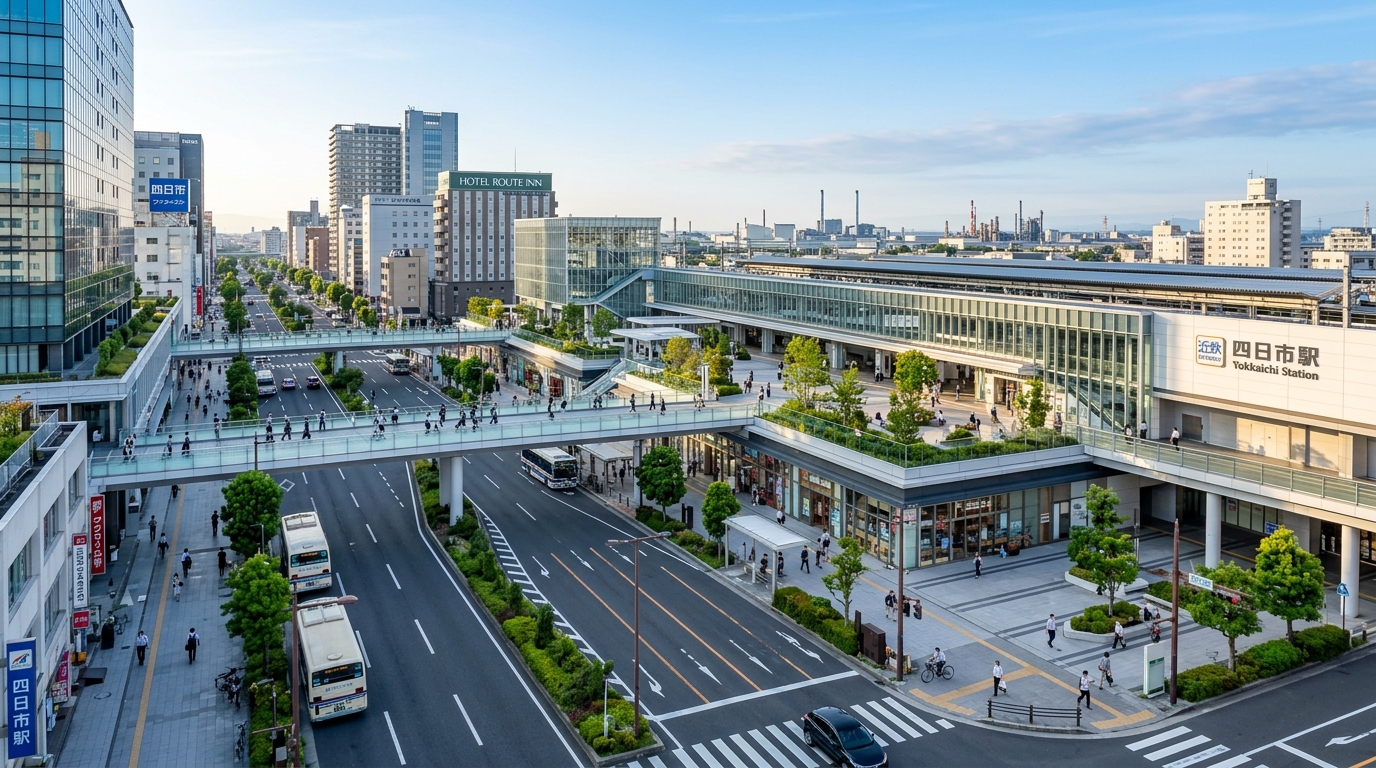
1. Why Yokkaichi City Is Drawing Attention: The Double Impact of the Semiconductor Industry and Station-Front Redevelopment
| Item | Yokkaichi City Empirical Data (2021–2025 Actuals) |
|---|---|
| Nearest Station | Kintetsu-Yokkaichi Station (Kintetsu Railway) |
| Daily Passenger Volume | 43,417 passengers |
| Average Transaction Price | Approx. ¥21.86 million |
| Median Transaction Price | ¥14.00 million |
| Sample Size | 4,445 transactions |
The primary reason Yokkaichi City is capturing intense focus in the real estate market lies in the simultaneous, dramatic evolution of its twin pillars: industry and urban infrastructure.
The two most crucial factors dictating real estate value in regional cities are sustainable local employment and a vibrant urban core. Yokkaichi fulfills both requirements at an exceptionally high level. The presence of one of the world's largest semiconductor memory production complexes, centered around Kioxia, extends far beyond a simple industrial plant—it generates tens of thousands of high-income jobs across supply chains and related enterprises.
At the same time, the area surrounding Kintetsu-Yokkaichi Station, which serves 43,417 passengers daily, is transforming from a Showa-era streetscape into a next-generation urban center. Real estate transaction data from the past five years (2021–2025) across 4,445 sample transactions shows an average transaction price of approximately ¥21.86 million and a median price of ¥14.00 million. This demonstrates a significantly lower barrier to homeownership compared to major metropolitan cores, making it an extraordinarily attractive price range for primary homebuyers.
With industrial concentration bolstering underlying demand and downtown redevelopment elevating urban appeal, Yokkaichi City sits right on the threshold of sustained asset appreciation.
2. The Full Scope of the 2028 Kintetsu-Yokkaichi Station Redevelopment: Evolving Bus Terminals and Commercial Hubs
| Timeline | Major Redevelopment & Infrastructure Schedule in Yokkaichi City |
|---|---|
| August 2025 | Yokkaichi Sanko Building, one of Mie's largest office buildings, opened |
| April 2026 | Construction begins on the multi-use Yokkaichi Sanko Building ANNEX |
| Around June 2026 | Circular pedestrian deck "Yonmaru Terrace" at Kintetsu-Yokkaichi Station East Exit opens to public |
| November 2026 | Scheduled opening of new commercial facility "Across Plaza Yokkaichi" (tentative name) |
| Spring 2028 | Grand opening of Yokkaichi Sanko Building ANNEX (hotel & retail complex) |
| Ongoing | Development of "Busta Yokkaichi," a major transit hub under the national "Busta Project" |
In real estate investment and home purchasing, tracking redevelopment timelines is essential for identifying the precise window to buy. In Yokkaichi, a series of transformative projects are lined up with 2028 serving as a key milestone.
Under the Chuo-dori Avenue Redevelopment Project around Kintetsu-Yokkaichi Station, the circular pedestrian deck "Yonmaru Terrace" has already opened, dramatically improving pedestrian flow and connectivity. Another upcoming flagship landmark is the 13-story mixed-use Yokkaichi Sanko Building ANNEX, scheduled to open in spring 2028. Retail space will occupy the first floor, while upper floors will house Sanko Inn Grande Yokkaichi, an upscale hotel brand featuring 152 guest rooms. Integrated with the adjacent office-centric Yokkaichi Sanko Building (opened in August 2025), this complex is engineered to aggregate business, hospitality, and retail functions right at the station front, driving massive foot traffic.
Efforts to enhance daily living convenience extend beyond the main station plaza. In November 2026, a new commercial complex, provisionally named "Across Plaza Yokkaichi," is slated to open in the Higashi-akuragawa area, anchored by a supermarket and pharmacy.
Furthermore, national initiatives such as the "Busta Yokkaichi" integrated bus terminal and plans for a new city library are progressing. This ongoing infrastructure upgrade solidly supports land values in surrounding commercial zones (which feature an 80% building coverage ratio and 400% floor area ratio potential) and strongly incentivizes long-term residency for families and working professionals alike.
3. Expanding Job Creation and Housing Demand Driven by a Global Semiconductor Hub
| Item | Facts on Semiconductor Industry Hub |
|---|---|
| Primary Base | Kioxia Yokkaichi Plant (one of the world's largest flash memory production facilities) |
| Site Area | Approx. 694,000 m² (spanning approx. 1.4 km end-to-end) |
| Investment Scale | Total planned investment of approx. ¥5 trillion across Yokkaichi and Kitakami by 2032 (announced August 2026) |
| Latest Facility | Fab 7 (Y7) currently operational; phased equipment installation ongoing |
Any discussion of Yokkaichi's housing demand must highlight the Kioxia Yokkaichi Plant. Spanning approximately 690,000 square meters and extending 1.4 kilometers from end to end, this facility functions like a self-contained city. Driven by surging demand for flash memory in AI-oriented data centers, the plant has entered a new phase of expansion.
In August 2026, Kioxia and Western Digital / SanDisk announced plans for a mega-investment totaling approximately ¥5 trillion across their Japanese facilities (Yokkaichi and Kitakami) through 2032, backed by government subsidies. At the Yokkaichi Plant, the state-of-the-art Fab 7 (Y7) is already operating, with production capacity set to expand incrementally in response to global market trends.
Hosting the world's primary volume manufacturing hub in Yokkaichi does more than boost municipal tax revenues—it guarantees a steady influx of high-purchasing-power residents, including engineers, researchers, and corporate transferees.
This employment growth directly energizes the residential housing market. Single young tech workers seek convenient modern apartments (1LDK to 2LDK) near Kintetsu-Yokkaichi Station, while established mid-career professionals target suburban single-family homes (3LDK to 4LDK) in family-friendly neighborhoods. While subject to standard semiconductor industry cycles, medium- to long-term housing demand remains exceptionally resilient, serving as the primary engine driving Yokkaichi's land values.
4. Livability and Environment in Yokkaichi: Perspectives for Families and Singles
| Infrastructure & Support Schemes | Specific Details & Data |
|---|---|
| School Districts & Education | Kaizo Elementary School, Yamate Junior High School, etc. |
| Medical Facilities | 21 facilities in the local area (including Ninomiya Medical Clinic, Nishimura Internal Medicine & Pediatrics, Yokkaichi City Emergency Clinic) |
| Subsidies for New Builds | "Smart City Construction Promotion Subsidy" (supports ZEH, solar, and battery storage adoption) |
| Relocation Subsidies | "Support Project for Relocation of Households with Children / Young Couples" (subsidizes property tax equivalents for 2–4 years on pre-owned home acquisitions) |
When selecting a primary residence, daily livability is just as critical as future asset value. While Yokkaichi is known as an industrial powerhouse, it doubles as an attractive suburban community equipped with robust everyday infrastructure and family support programs.
Local transaction data indicates that the area contains well-established public schools such as Kaizo Elementary School and Yamate Junior High School. Healthcare infrastructure is equally well developed, with 21 medical facilities identified, including Ninomiya Medical Clinic, Nishimura Internal Medicine & Pediatrics, and the Yokkaichi City Emergency Clinic for after-hours needs—ensuring complete medical coverage from routine checkups to urgent care.
Generous municipal housing incentives further enhance the market. Yokkaichi City offers local subsidies that can be combined with national programs like the "Mirai Eco Housing 2026 Project." Homeowners purchasing new builds can utilize the "Smart City Construction Promotion Subsidy" when installing solar panels, battery storage, or meeting ZEH (Zero Energy House) standards, significantly offsetting initial capital expenditures.
To stimulate the pre-owned housing market, the city also operates the "Support Project for Relocation of Households with Children / Young Couples." Families moving from outside the city or transitioning from rental housing who acquire a pre-owned single-family house receive subsidies equivalent to their property tax for up to 2 to 4 years (capped between ¥200,000 and ¥400,000).
These assistance programs provide significant financial relief for families seeking quality living environments on a reasonable budget. For single professionals, the close proximity of healthcare, retail, and transit facilities delivers a exceptionally high quality of life.
💡 [Reader Exclusive] Don't Miss the Optimal Timing for Investment or Purchase In fast-evolving markets like Yokkaichi, high-value properties frequently transact off-market. To receive detailed market reports tailored to your life stage and gain access to unlisted property updates, we recommend leveraging specialized real estate intelligence platforms to monitor market trends regularly.
5. Land Price Trends and Key Residential Areas in Yokkaichi (Station-Proximity vs. Suburban Residential)
| Sample Transaction | Property Type | Transaction Price | Size / Layout | Year Built | Zoning / Urban Planning |
|---|---|---|---|---|---|
| Horiki | Pre-owned Condominium | ¥8.8 million | 95 m² / 4LDK | 1983 | (Unspecified) |
| Hinaga-higashi | Residential Land & Building | ¥16.0 million | 175 m² / 4LDK+S | 2004 | Quasi-Industrial Zone |
| Higashi-shinmachi | Residential Land & Building | ¥25.0 million | 195 m² / 4LDK | 2021 | Type 2 Residential Zone |
Analyzing actual sales records reveals clear patterns in Yokkaichi's residential market. Between 2021 and 2025, the average transaction price stood at approximately ¥21.86 million, with an average unit price of roughly ¥42,000/m².
Buyer preferences divide into two distinct strategies based on lifestyle needs: The first is the "station-adjacent, convenience-first" condominium market. In the Horiki area, for example, a 95 m² 4LDK unit built in 1983 transacted at ¥8.8 million. Although older, it directly benefits from station-front revitalization, representing a highly cost-effective renovation opportunity for singles or DINKS (double income, no kids).
The second is the "suburban, space-focused" single-family home market. In Higashi-shinmachi, a 195 m² 4LDK home built in 2021 sold for ¥25.0 million. Designated as a Type 2 Residential Zone, it offers a peaceful neighborhood setting while keeping industrial sites and shopping centers easily accessible by car. Similarly, properties like the 2004-built home in Hinaga-higashi (¥16.0 million) offer generous lot sizes (175 m²) even within Quasi-Industrial Zones, presenting high value for growing families.
6. Property Selection and Future Asset Value Retention for Homebuyers
| Risk Factor | Hazard Assessment Based on Local Data |
|---|---|
| Flood Risk | [Risk Identified] Maximum inundation depth Level 3 (3–5 meters) |
| Landslide / Sediment Risk | [No Risk] No sediment disaster hazard designation |
To safeguard long-term asset value when purchasing a home in Yokkaichi, assessing natural disaster risks is imperative.
According to local dataset analysis, while there are no designated landslide hazard areas in the target sector, certain flood risk zones fall under "Maximum Inundation Depth Level 3 (3–5 meters)." A flood depth of 3 to 5 meters means water levels could reach the second floor of a standard single-family home.
Reviewing municipal hazard maps before purchasing is mandatory, but entering a flood-prone area does not automatically rule out buying. Risk can be mitigated through smart design and selection: buyers can opt for condominium units on the 3rd floor or higher, or build detached homes with elevated foundations, raised living spaces, and mechanical equipment (such as water heaters) positioned above flood levels.
Evaluating environmental hazards objectively and choosing flood-resilient properties serves as a powerful safeguard against future resale value depreciation.
7. Evaluating Yokkaichi's Real Estate Potential Through "Mekiki Research" Market Data
| Data Indicator | Key Analytical Highlights |
|---|---|
| Transaction Volume Depth | A robust sample size of 4,445 transactions confirms market liquidity and transparent pricing. |
| Urban Planning Advantages | 80% coverage and 400% floor area ratios in commercial zones enable high-density downtown redevelopment. |
| Infrastructure Completeness | Daily station foot traffic exceeding 40,000 and 21 medical clinics quantify the city's strong foundation. |
Purchasing real estate or investing in property represents one of life's largest financial commitments. Objective decision-making based on verified empirical data—rather than speculative trends—is essential.
The figures in this article were retrieved in real time using official datasets from the Ministry of Land, Infrastructure, Transport and Tourism (MLIT) API and Geospatial Information Authority hazard data. A robust volume of 4,445 transactions proves that Yokkaichi's real estate market is driven by healthy end-user transactions rather than short-term speculative capital.
Furthermore, urban planning parameters such as zoning codes (commercial coverage of 80% and floor area ratios of 400%) serve as critical metrics indicating future development potential (e.g., maximum floor height allowance and commercial density). Understanding these regulatory frameworks gives buyers a distinct strategic advantage in evaluating long-term asset value in a redeveloping city.
8. Conclusion: Smart Housing Decisions in a Continuously Growing Yokkaichi
Driven by the countdown to the 2028 station redevelopment and Kioxia's ongoing ¥5 trillion investment roadmap into the 2030s, Yokkaichi City is entering a golden era as a key regional hub.
A steady stream of employment opportunities, strong childcare support, and solid local infrastructure make Yokkaichi well suited for diverse lifestyles—from young professionals to growing families. At the same time, carefully reviewing flood maps and relying on verified market data are crucial prerequisites for a confident home purchase.
In real estate, the optimal buying window often occurs just before a city's major transformations fully materialize. As the full scale of Yokkaichi's redevelopment comes into view, now represents the ideal moment to begin your property search.
By registering for a free account, you can access the MLIT real estate datasets used in this article directly through your Claude or ChatGPT workflows (via MCP integration). Leverage AI to streamline your personalized property research seamlessly today.