
Since the opening of the Tsukuba Express (TX), cities along the railway line have undergone dramatic transformations. The area around Nagareyama Otakanomori Station in Nagareyama City, Chiba Prefecture (Chiba-ken Nagareyama-shi) stands out as a prime example of this success. Driven by the brilliant catchphrase, "If you are becoming a mother, choose Nagareyama." (Haha ni naru nara, Nagareyama-shi.), the city has strongly promoted unique childcare support measures, such as its nursery transit station system. As a result, it has consistently recorded one of the highest population growth rates in Japan.
By 2026, as the station-front redevelopment matures, the area's real estate market is entering a new phase. It is transitioning from an initial period of rapid land price surges into a mature phase characterized by stable asset values and further quality improvements. In this article, we will thoroughly analyze the trajectory of residential land prices and rapid population growth in the Nagareyama Otakanomori area. This analysis is backed by actual data from 2021 to 2025, including real estate transaction price information from the Ministry of Land, Infrastructure, Transport and Tourism (MLIT) and hazard data from the Geospatial Information Authority of Japan (GSI).
For real estate investors, high-net-worth individuals, and those looking to buy a home as an owner-occupier, an objective, data-driven area analysis is indispensable. Through this article, we will uncover the fundamental value and future potential that explain why Nagareyama City continues to receive such high praise, alongside the risk factors that must be evaluated before making a purchase.
💡 Check the latest land prices and hazard information for the Nagareyama Otakanomori area right now! Determine the best timing for investment or purchase based on detailed transaction data by area. Check the latest information on Nagareyama City, Chiba Prefecture on Mekiki Research 👉
First, let's look at a summary of the real estate market and land price trends in the Nagareyama Otakanomori area based on the latest data.
| Indicator | Actual Data (2021–2025 Results) |
|---|---|
| Target Area | Nagareyama City, Chiba Prefecture (Around Nagareyama Otakanomori: lat=35.8719, lng=139.9256) |
| Number of Transactions | 3,902 |
| Average Transaction Price | Approx. 43.76 million yen |
| Median Transaction Price | 38.00 million yen |
| Average Unit Price | Approx. 190,000 yen/sqm |
| Daily Station Passengers | 58,200 (Nagareyama Otakanomori Station / Metropolitan Intercity Railway Company) |
| Medical Facilities | 22 facilities |
| Hazard Risks | Flood risk present (Max inundation depth: 0.5–3m) / No landslide risk |
This data indicates that Nagareyama City has developed a highly active real estate market. Now, let's dive into the detailed analysis.
1. Introduction: The Opening of the Tsukuba Express and Nagareyama Otakanomori Today
The opening of the Tsukuba Express (TX) in 2005 dramatically improved access from northwestern Chiba Prefecture to central Tokyo, causing a paradigm shift in the real estate market along the line. Among the stations operated by the Metropolitan Intercity Railway Company (Shutoken Shintoshi Tetsudo), Nagareyama Otakanomori Station has been a core hub that has achieved exponential growth since its opening.
According to the data obtained, as of 2026, the daily passenger volume at this station has reached 58,200, making it one of the premier transit nodes on the TX line. The overwhelming convenience of reaching Akihabara in as little as twenty-odd minutes has heavily driven housing demand among high-earning dual-income couples and affluent professionals working in central Tokyo. From an investor's perspective, this robust transportation infrastructure and high passenger volume serve as crucial fundamentals that support solid rental demand and mitigate the risk of future asset depreciation.
2. Demographic Trends in Nagareyama City: The Trajectory of Rapid Growth from the TX Opening to 2026
The population of Nagareyama City has experienced a complete turnaround from the stagnation prior to the TX opening, continuing a rapid and steady upward trend. In particular, the net influx of the child-rearing generation in their 30s and 40s has remained among the highest nationwide. This influx has rejuvenated the city's demographic pyramid, facilitating vibrant urban development.
The driving force behind this rapid population growth is not just convenient transportation, but also the strategic city branding championed by the municipal government. The growing population boosts the city's tax revenue, which is subsequently reinvested into infrastructure development and childcare support initiatives—creating an ideal "virtuous cycle" for a local municipality.
On the other hand, an emerging challenge is that the rapid population influx is beginning to test the capacity limits of local infrastructure, such as road networks and schools. However, the city has proactively revised its urban planning to stay ahead of these issues. This commitment to sustainable growth fosters long-term confidence within the real estate market.
3. "If you are becoming a mother, choose Nagareyama": The Impact of Childcare Support Measures Like the Nursery Transit Station
When discussing the real estate value of Nagareyama City, it is impossible to overlook its unique childcare support measures, epitomized by the catchphrase "If you are becoming a mother, choose Nagareyama." Notably, the "Nursery Transit Station" (Sogei Hoiku Station) system—where parents can drop off their children at a facility near the station to be shuttled by bus to various daycares across the city—has garnered nationwide attention as a revolutionary system that drastically reduces the commuting burden on working parents.
The educational environment is also highly developed. According to our data, the area is served by school districts such as Yagikita Elementary School (Yagikita Shogakko) and Oguronomori Junior High School (Oguronomori Chugakko). The planned expansion of educational infrastructure, including the construction of new schools, acts as a powerful incentive to attract education-conscious families.
Furthermore, the abundance of medical facilities is a standout feature. There are 22 medical institutions clustered around the station, offering a variety of specialized care, including Life Garden Chuo Clinic (Iryo Hojin Shadan Shinnotsubasa Life Garden Chuo Clinic), Yonetani Clinic (Yonetani Clinic), and Maruyama Dermatology Clinic (Maruyama Hifuka). Ensuring reliable access to daily medical care meets the needs of not only families with young children but also future senior residents, significantly contributing to the long-term stability of real estate values.
💡 For those looking to dive deeper into Nagareyama City's micro-data from an investment perspective The quality of school districts and the availability of medical facilities are key indicators for avoiding long-term vacancy risks. Analyze the surrounding environment data of the Nagareyama City area on Mekiki Research 👉
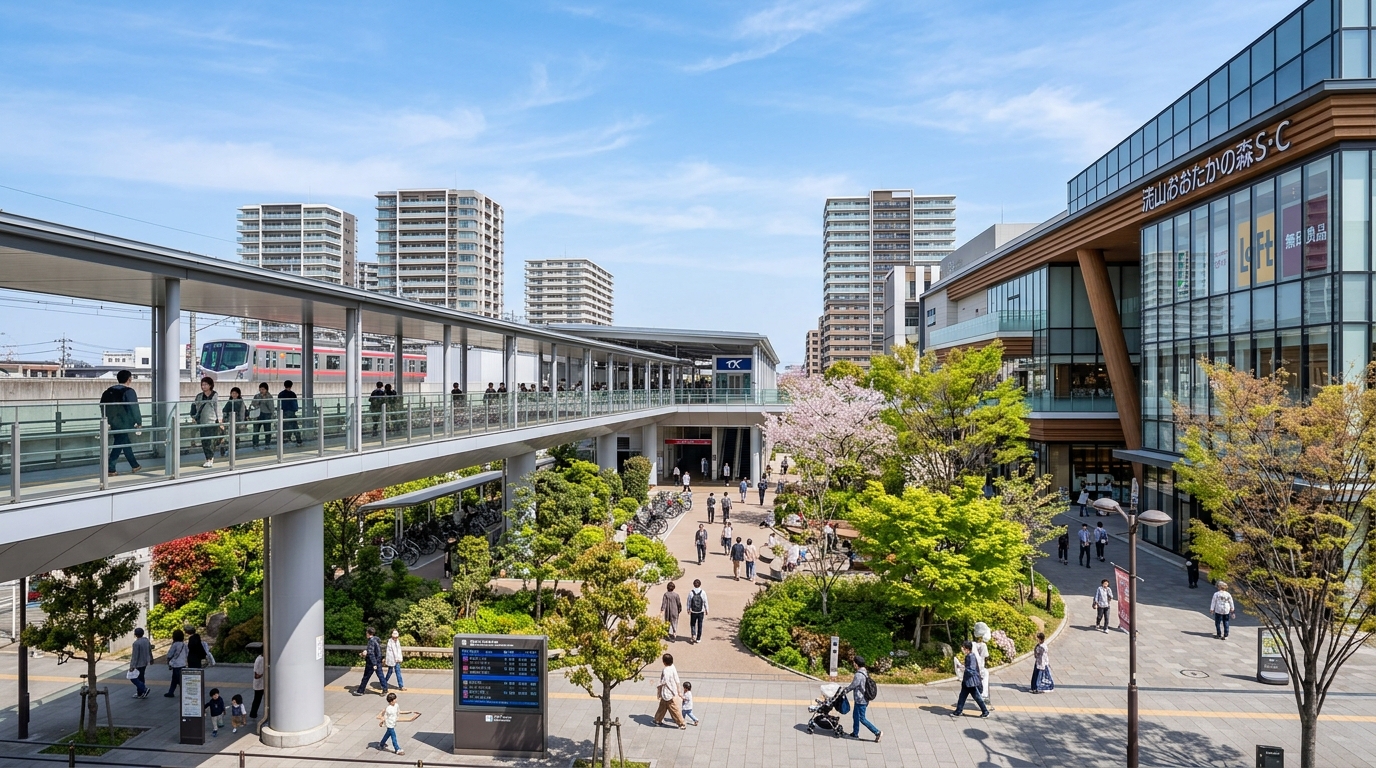
4. The Full Picture of Station Area Redevelopment: Clustering of Large Commercial Facilities and Enhanced Urban Functions via West and South Plazas
The comprehensive redevelopment around Nagareyama Otakanomori Station is not a haphazard sprawl of retail shops; rather, it is based on meticulous urban planning designed to harmonize with a lush, green residential environment. Centered around a large commercial complex directly connected to the station, the development of the West and South exit plazas has progressed. This has created safe pedestrian pathways separated from vehicular traffic, along with welcoming public spaces where residents can relax.
This redevelopment has transitioned from an initial phase focused on "improving convenience" to the next stage of "advancing urban functions." The clustering of hotels, office buildings, and cultural facilities has fostered a vibrant cityscape that thrives day and night.
In terms of real estate value, the development of station plazas and pedestrian decks adds a direct premium not only to nearby commercial land prices but also to residential land prices within walking distance. A redeveloped station area that seamlessly blends a beautiful cityscape with high convenience stimulates the desire of affluent buyers to purchase condominiums, acting as a growth engine that elevates property values across the entire area.
5. Residential Land Price Trends Around Nagareyama Otakanomori: Data Showing Continuous Appreciation of Asset Values
Now, let's analyze the residential land price trends around Nagareyama Otakanomori based on actual transaction data from 2021 to 2025. According to the data obtained, the sample size of real estate transactions in Nagareyama City during this period reached 3,902, confirming an extremely liquid and active market.
The overall average transaction price is approximately 43.76 million yen, with a median of 38.00 million yen, maintaining a high level compared to other areas in Chiba Prefecture. The average unit price stands at about 190,000 yen per square meter, indicating very strong price formation given the distance from central Tokyo.
Particularly noteworthy is that while the minimum transaction price was 30,000 yen, the maximum reached 1.3 billion yen. This suggests an influx of capital from a broad spectrum of buyers, ranging from standard owner-occupier families to large-scale commercial and investment real estate players. The reason the average (approx. 43.76 million yen) exceeds the median (38.00 million yen) is that a few high-value transactions are pulling the average up. However, the median figure of 38.00 million yen perfectly aligns with the purchasing power of the upper-middle class seeking primary residences.
Looking at the environmental data for the entire area, the "Category I Exclusively Low-Rise Residential Zone" (Dai-isshu Teiso Jukyo Senyo Chiiki) is widespread, strictly preserving a spacious living environment with a building coverage ratio of 60% and a floor area ratio of 150%. The safeguarding of this favorable living environment is the most significant factor in preventing unchecked development and ensuring medium- to long-term stability in land prices.
6. Latest Trends in the Condominium and Detached House Markets Driven by the Influx of Families (2026 Edition)
Taking a more micro perspective, we will delve into the latest trends in the condominium and detached house markets using specific transaction samples.
In the Oaza Ki (Oaza Ki) area, a 3LDK (3-bedroom) pre-owned reinforced concrete condominium built in 2017 with a floor space of 75 sqm was traded for approximately 34 million yen. This area is designated as a "Category I Exclusively Medium-to-High-Rise Residential Zone" (Dai-isshu Chukoso Jukyo Senyo Chiiki). Condominiums are supplied here by maximizing the floor area ratio, and they are strongly favored by demographics seeking a balance between station access and a pleasant living environment.
Turning to the detached house market, in the Nonoshita (Nonoshita) area (Category I Exclusively Low-Rise Residential Zone, building coverage ratio 60%, floor area ratio 150%), a 3LDK wooden detached house built in 2000 with a lot size of 165 sqm traded for about 26 million yen. A property of the same size built in 1978 sold for approximately 17 million yen. While the price difference based on the age of the building is clear, the ability to secure a spacious lot (165 sqm) remains highly competitive for homebuyers, especially following the widespread adoption of remote work.
Additionally, in the Oaza Hiregasaki (Oaza Hiregasaki) area (Category I Exclusively Medium-to-High-Rise Residential Zone, building coverage ratio 60%, floor area ratio 200%), a 4LDK lightweight steel-framed detached house built in 1999 with 180 sqm of space traded at a high price of around 42 million yen. In stark contrast, a 100 sqm property built in 1983 in the Hiregasaki (Hiregasaki) area (Category II Residential Zone) went for about 8 million yen. The data clearly illustrates a polarization in prices based on distance from the station, zoning designations, and building age.
As for nearly new properties, a 4LDK wooden detached house built in 2021 with 120 sqm in the Mita (Mita) area (Category I Exclusively Low-Rise Residential Zone) traded for approximately 31 million yen. This corroborates the strong owner-occupier demand from young families seeking a high-quality residential environment.
7. Future Outlook: Infrastructure Challenges and Measures for Sustainable Urban Development
When looking ahead at the future of the real estate market around Nagareyama Otakanomori, addressing natural disaster risks is unavoidable.
According to hazard information from the Geospatial Information Authority of Japan, the risk of landslides in this area is assessed as "None (hasRisk: false)." However, a flood risk is marked as "Present (hasRisk: true)," with some areas falling under a maximum inundation depth of Rank 2 (0.5 to 3 meters).
It is essential for real estate investors and prospective homebuyers to check this hazard map before purchasing. Evaluating resilience against flood risks—such as checking the floor level where a condominium's electrical equipment is installed, the foundation height of a detached house, or the inclusion of water damage coverage in fire insurance—is critical. As localized torrential rains caused by climate change increase in recent years, the presence or absence of hazard risks has become a crucial factor directly tied to future asset value and liquidity.
The municipal administration is well aware of this issue and continues to invest in infrastructure aimed at sustainable urban development, such as constructing rainwater storage facilities and improving river systems. These disaster prevention and mitigation efforts will ultimately secure the area's long-term brand value.
8. Conclusion: The Real Estate Investment Potential of Nagareyama City Created by Childcare Support and Urban Development
In this article, we analyzed the transformation of real estate in Nagareyama City, Chiba Prefecture, from the opening of the Tsukuba Express to the present, based on the latest actual data.
In conclusion, the impact on real estate value is exceptionally positive. The unique childcare support measures backed by the slogan "If you are becoming a mother, choose Nagareyama." combined with the meticulously planned station area redevelopment have successfully realized a massive track record of 3,902 transactions and a robust average price formation of approximately 43.76 million yen. The educational environment, including Yagikita Elementary School and Oguronomori Junior High School, the clustering of 22 medical institutions, and the strict preservation of the living environment centered around Category I Exclusively Low-Rise Residential Zones are not fleeting trends. Rather, they are solid fundamentals that support long-term asset value.
While there are current challenges to note, such as infrastructure capacity limits and flood hazard risks (maximum inundation depth of 0.5 to 3 meters), Nagareyama City possesses more than enough growth potential and administrative execution capability to overcome them. We are confident that it will continue to be one of the most promising real estate markets in the Tokyo metropolitan area, attracting an ongoing influx of both primary residential demand from child-rearing families and robust investment capital.
【Related Articles】